


A starter can look busy, smell tangy, and still be changing in ways your eyes cannot measure. A new study tested a rapid, dual test meant to spot both a target sourdough bacterium and a competing microbe during repeated feedings.
The practical home-baker lesson is not “buy a test.” It is to learn what your own healthy starter does, then notice when its rise, aroma, texture, and timing shift together.
This is early, controlled research for sourdough production settings, not a diagnostic tool for every jar on a home counter.
At a Glance
|
 AI generated photo for American Sourdough Association. |
What researchers actually tested
The researchers developed two lateral-flow immunochromatographic assays, the same broad family of visual-strip technology used in other rapid tests. One was designed to detect a common sourdough-associated bacterium; the other was designed to flag a competing group of organisms.
They inoculated sourdoughs, then maintained them through daily backslopping, taking a portion of ripe culture and feeding it fresh flour and water, at 23°C, 30°C, and 37°C for four days. The complete methods and limitations are available in the publisher’s article record.
At 37°C, the test for the competing organism became positive by day four. Sequencing showed the focal starter bacterium had fallen to 6.2% relative abundance, while Pediococcus became dominant in that model.
The point is not that 37°C “ruins” every starter. It shows why a single familiar metric can miss a microbial change under a specific set of laboratory conditions.
Why a normal pH reading is not the whole story
In the high-temperature model, pH dropped below 4.5, and total lactic-acid-bacteria counts looked broadly similar across temperatures. Those conventional readings did not reveal the same change that sequencing and the dual assay did.
pH tells you about acidity, not the full identity of the community. That is a useful distinction for producers managing consistency at scale. It is also a reminder that home bakers should not reduce starter health to one number, one smell, or one bubble pattern. |
 AI generated photo for American Sourdough Association. |
What this means in a home kitchen
Most home bakers do not need a microbial assay. The study itself frames the tool as promising for industrial and artisanal sourdough production, and it was evaluated with specific strains, controlled temperatures, and daily back-slopping.
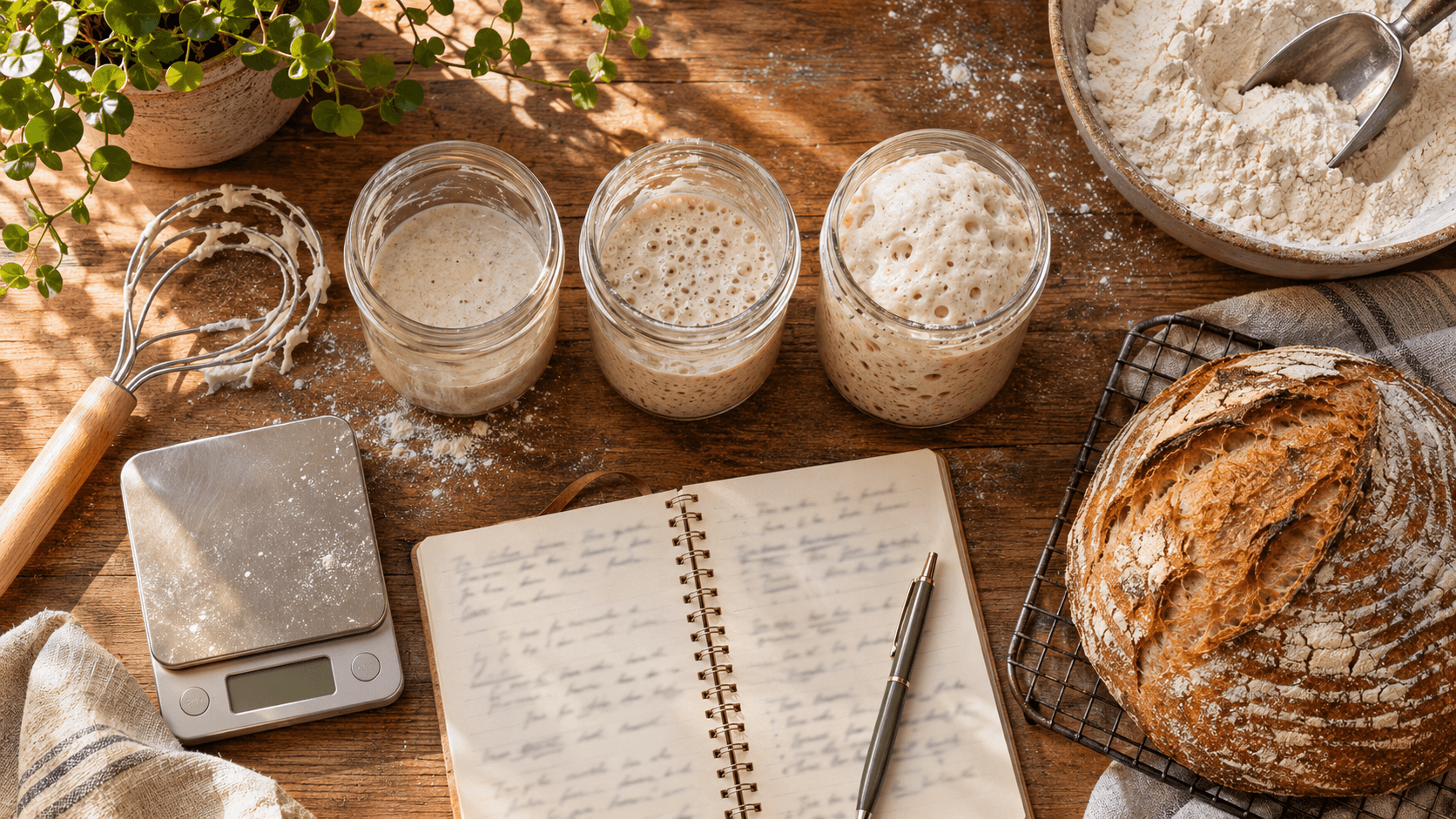
Still, the research supports a good home practice: establish a baseline before troubleshooting. A starter is easier to read when you know its usual feeding ratio, room temperature, time to peak, aroma, and texture.
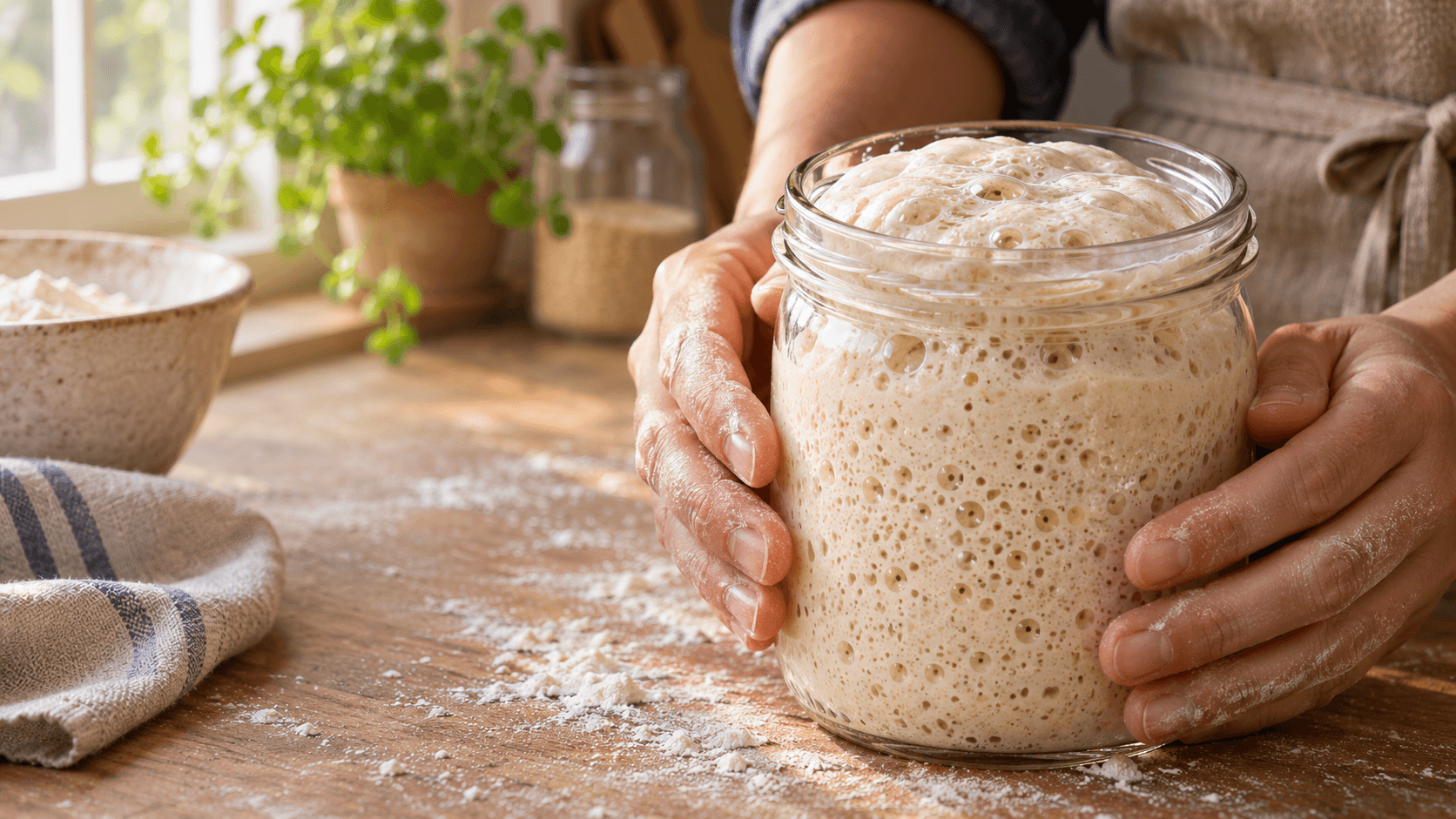
A starter that peaks faster or slower is not automatically unsafe or “contaminated.” It may simply be responding to temperature, flour, feeding rhythm, or hydration.
The recent microbiome research on flour and feeding schedule makes that point from another angle: flour type influenced bacterial communities, while the tested feeding schedules did not produce the same effect for every organism. |
 AI generated photo for American Sourdough Association. |
When a starter needs attention
Use your senses and common food-safety judgment. A healthy pattern can vary. Visible mold, pink or orange discoloration, or a genuinely putrid smell is different from a normal acidic or solvent-like phase caused by hunger.
If you see mold or unusual colored growth, the conservative choice is to discard the culture and clean the container before starting again. Do not try to rescue visible mold by scraping the surface.
For ordinary sluggishness, begin with simpler checks:
The HealthFerm citizen-science study is a useful reality check: household sourdough practices vary widely, and fermentation results need to be read in the context of each baker’s own process.
The research gap to keep in view
The new assay produced a visual yes-or-no result within about an hour and did not require specialized equipment. But its reported specificity and cross-reactions matter. A positive signal for the competing-microbe assay was not a simple, species-perfect verdict.
That nuance is exactly why home bakers should not overinterpret a future strip test, or a single kitchen observation. The study is valuable because it shows what researchers may be able to monitor faster, not because it replaces sound starter care.
The Bottom Line
This study offers a promising quality-control concept for sourdough makers who need to catch microbial shifts early. In a controlled model, the dual assay revealed a change that pH and total LAB counts did not make obvious.
For home bakers, the immediate takeaway is more grounded: use a clean jar, keep notes, feed consistently enough for your schedule, and judge your starter by a whole pattern of evidence rather than one metric.
There is no need to chase laboratory precision at the counter. Build a repeatable routine, compare your starter to its own normal behavior, and adjust one variable at a time when the loaf tells you something has changed.
For a deeper read, compare the full study record with the visual abstract, then return to a practical feeding schedule that fits your own kitchen. |
30 Comments
Join the conversation
I like the focus on changes happening together. One strange smell worries me less when my starter still rises on schedule.
The Pediococcus signal is interesting, though I would want to know more before calling it a problem in every starter.
I have been guessing when my starter peaks and sometimes miss it completely. Writing down the timing for a week seems easy enough.
Hannah PriceI started marking the jar with a rubber band after each feeding. It made the peak a lot easier to catch.
My kitchen is nowhere near 37°C most of the year. I hope they test slower, cooler feedings next.
Tessa M.Same here. Mine takes nearly twice as long to peak in winter, so cooler feedings would be good to study.
It helps to see the distinction between a lab finding and home-baking advice. I will keep an eye on patterns, not one odd day.
I wonder whether changing flour would affect the signs you are supposed to track. My starter acts different whenever I use rye.
The part about a busy-looking starter surprised me. I have definitely taken bubbles as proof that everything was going well.
I bake for a small cafe, so the production angle caught my attention. A test that spots changes before pH does could be valuable.
Rosa MartinezEspecially if a batch still looks and smells normal. I wonder how often you'd need to test for it to be useful in a cafe.
My starter smells sharper after I miss a feeding. It is helpful to know I should check its rise and texture too.
Keeping a record sounds tedious, but I could manage a quick note on feeding time and peak time. That might answer a few questions.
That target bacterium has quite a name. I am more comfortable tracking how my starter behaves than trying to identify what lives in it.
The four-day model is interesting, but I would not change my baking routine based on it yet. The home advice feels appropriately cautious.
I would like to know what a healthy range of peak times looks like after a feeding. Mine varies by several hours.
Texture is the one thing I rarely pay attention to with my starter. I might start noting that along with its rise.
The difference between total bacteria counts and which bacteria are present is interesting. I had assumed those numbers told the same story.
I am glad the test is not being presented as something home bakers need to buy. A notebook seems more manageable.
My starter can look bubbly long before it is ready to bake. The reminder to watch when it peaks is helpful.
I like that the study tracked a competing microbe during repeated feedings. It makes me wonder how much my feeding schedule changes things.
A dual test sounds useful for bakeries managing a lot of starters. For my one jar, I will stick with a simple feeding log.
The point about learning your own starter makes sense. Mine smells fruitier in summer, even when the bread turns out fine.
I had no idea pH could stay steady while the microbes change. That makes watching rise and timing together seem more useful.
It is reassuring to hear that every change does not mean contamination. My starter gets sluggish sometimes and bounces back after a feeding.
I appreciate the reminder that a tangy smell alone does not tell the whole story. I usually judge my starter by smell first.
The feed-and-peak record is a useful idea. My starter rises at different times depending on how warm my kitchen is.
Four days at 37°C sounds quite different from my kitchen counter. I would be curious whether the same shift happens at room temperature.
Leah P.I'd like to know that too. At room temperature, the shift might take longer than four days to show up.
You make a very fair point! Your kitchen counter is definitely a more realistic environment than a 37°C incubator. We chose the warmer temperature to speed up the reaction for the experiment, so at room temperature, you would likely see a similar shift—it would just take quite a bit longer to happen. Thanks for reading and sharing such a thoughtful question!