
Your wholemeal sourdough may look ready when it doubles, but what is happening inside the dough before you bake? A study examines what happens inside wholemeal sourdough when selected lactic acid bacteria ferment the dough alongside yeast. Its findings go beyond rise and flavor, tracing changes in starch, protein, small molecules and lipids.
That question is especially interesting with wholemeal flour, which brings bran, germ and a complex mixture of grain compounds into fermentation. For home bakers, the results offer a useful way to think about fermentation, without claiming that one culture makes a healthier loaf.
At a Glance
Why the rise is only part of the story
Yeast produces gas that helps dough expand. Meanwhile, bacterial fermentation changes acidity and the dough's chemical environment. Researchers can study these less visible changes by measuring the molecules present before and after fermentation.
Loaf height is a baking outcome; molecular composition is a different measurement. A higher rise alone cannot tell you which biochemical pathways were active, or whether a bread offers a particular health benefit. |
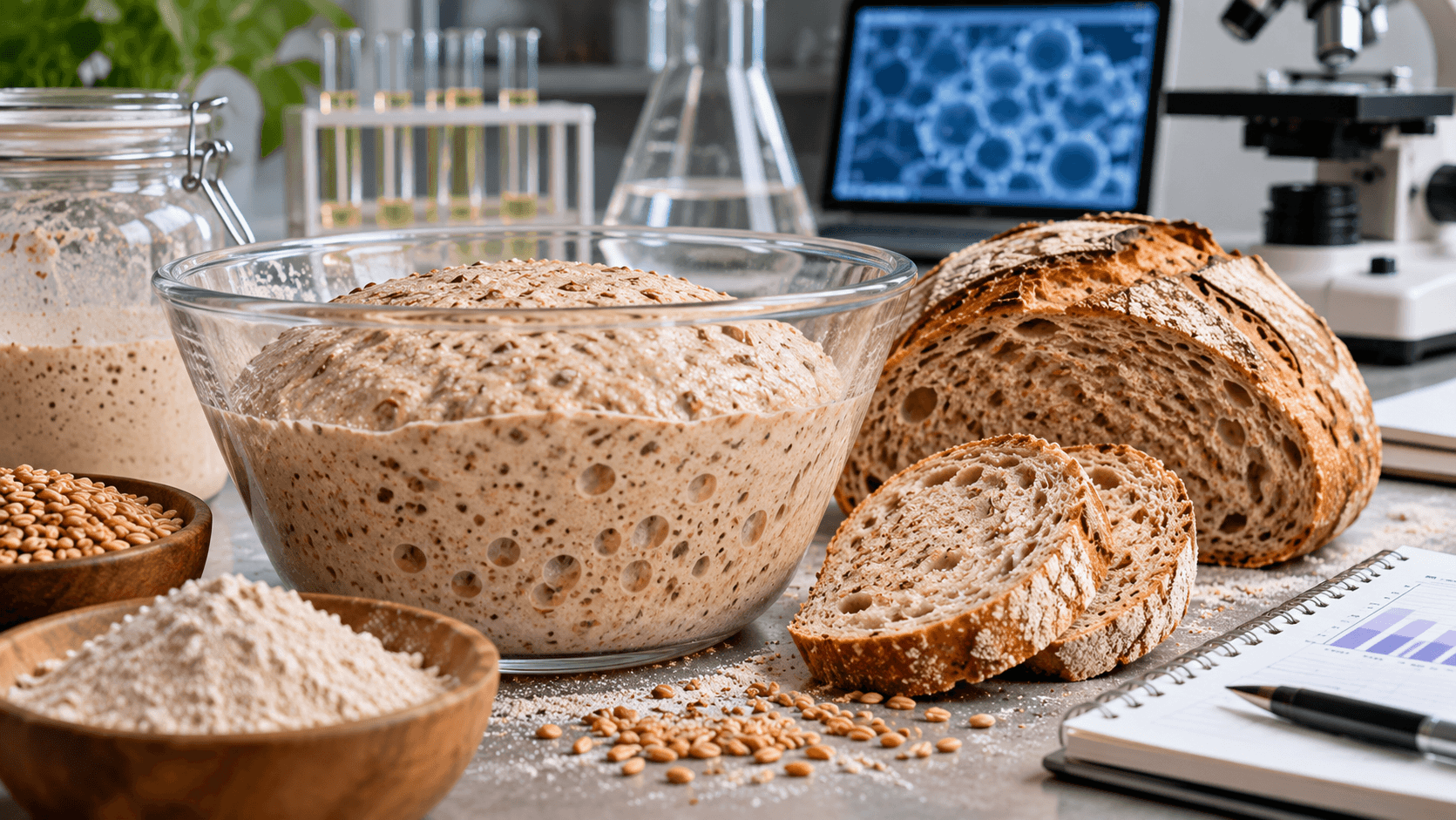 AI generated photo for American Sourdough Association. |
What the new research actually found
The researchers compared wholemeal sourdoughs fermented with four selected lactic acid bacterial strains: Pediococcus pentosaceus J28, Lactobacillus crustorum LMG, Lactobacillus fermentum YC-22 and Weissella cibaria T5. The published Food Chemistry abstract describes changes in starch and protein structures during fermentation.
Across the experimental doughs, the researchers reported 277–326 differential metabolites, including 210 shared differential metabolites. They also identified 458 lipid metabolites. These counts describe chemical features measured in the laboratory, not nutrients shown to be absorbed by people eating the bread.
What does “multi-omics” mean?
Think of it as examining the same dough through several scientific lenses. Metabolomics surveys small molecules, while lipidomics focuses on fats and related compounds. Structural methods look at changes in starch and proteins. Together, these approaches can reveal patterns that a single test might miss.
The study also used graph-based analysis to explore possible relationships among molecular changes. A connection in a computational network does not prove that one molecule caused a particular baking result or health effect.
A related 2026 wholemeal sourdough study examined phenolic compounds and antioxidant measurements. Its laboratory and simulated-digestion results should not be mistaken for demonstrated health benefits in humans. |
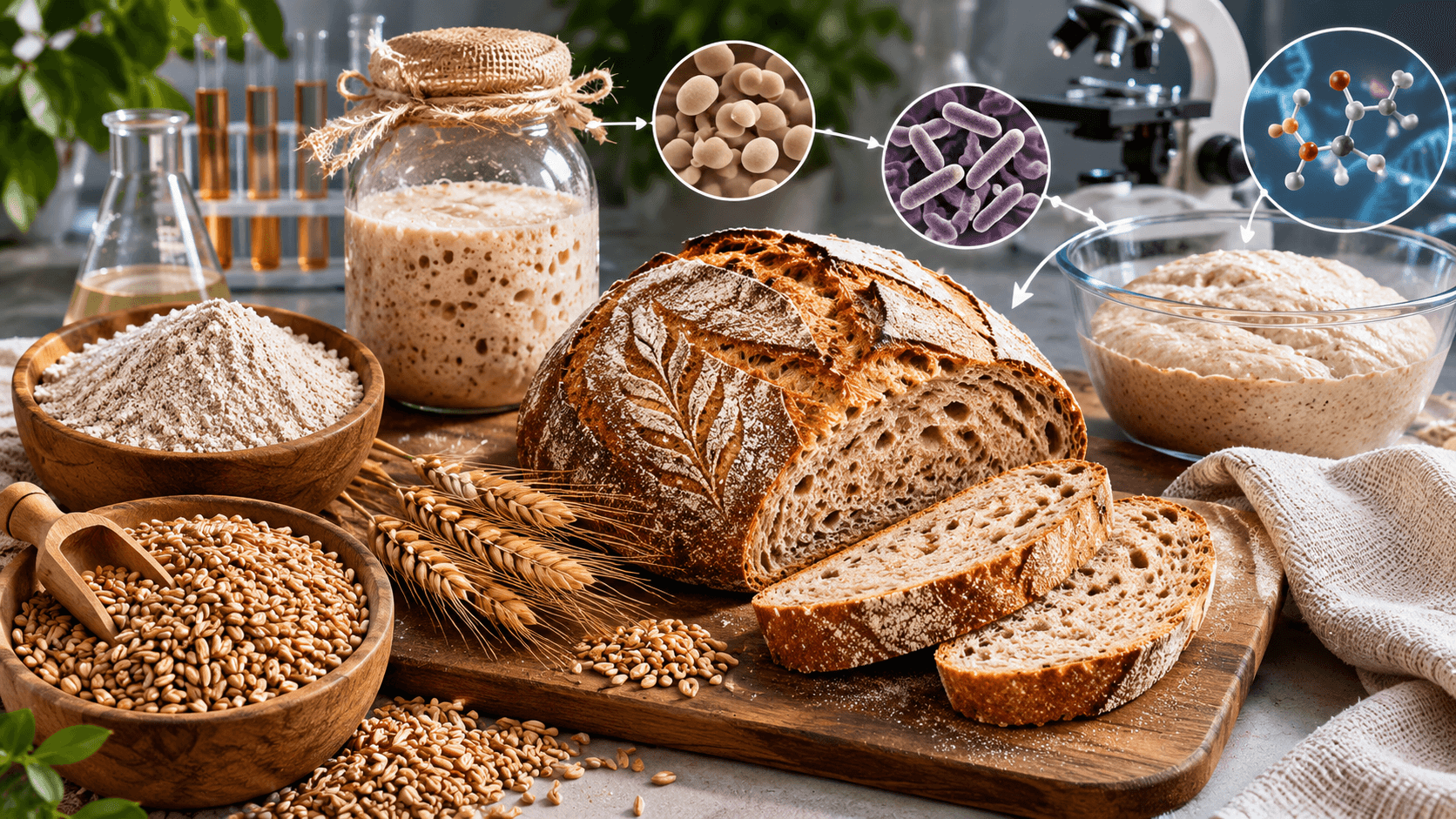 AI generated photo for American Sourdough Association. |
Why the choice of bacteria matters
Different bacteria can process sugars and other dough components differently. The Food Chemistry study found both shared and strain-associated metabolic patterns, showing why a sourdough culture should not be treated as a single, interchangeable ingredient.
That does not mean home bakers need to purchase an isolated laboratory strain. Most home starters are mixed communities whose behavior also depends on flour, temperature, hydration, and refreshment practices.
It was found that flour type influenced bacterial communities, while the yeast genus Kazachstania became abundant across the starters. This supports a practical point: changing flour can change more than dough texture.
What this does, and does not, say about nutrition
Fermentation can change the availability and composition of compounds in grain, but the presence of a molecular change does not establish a clinical benefit. A promising nutritional mechanism, emphasizing gaps in reproducibility and human-health evidence.
In a small 2026 crossover trial involving 20 healthy participants, whole-grain sourdough and yeast bread did not differ significantly on the overall primary gut-symptom measure. Some exploratory symptom and microbial differences were observed, but the authors called for more research.
Wholemeal sourdough is not automatically a probiotic food, a treatment for gut symptoms, or a substitute for medical dietary guidance. It also contains gluten when made from wheat.
What home bakers can actually apply
Three variables worth tracking: flour blend, dough temperature and fermentation duration. Each can affect the dough you handle, but the study does not establish a universal setting that works for every starter.
Use the research to ask better questions about your bake, rather than to promise a specific molecular result. If your goal is a softer crumb, better shape, or deeper flavor, choose one outcome and measure it consistently.
For a tested starting formula, see King Arthur Baking's whole-wheat sourdough recipe. It includes instant yeast, so keep that ingredient unchanged when comparing batches. |
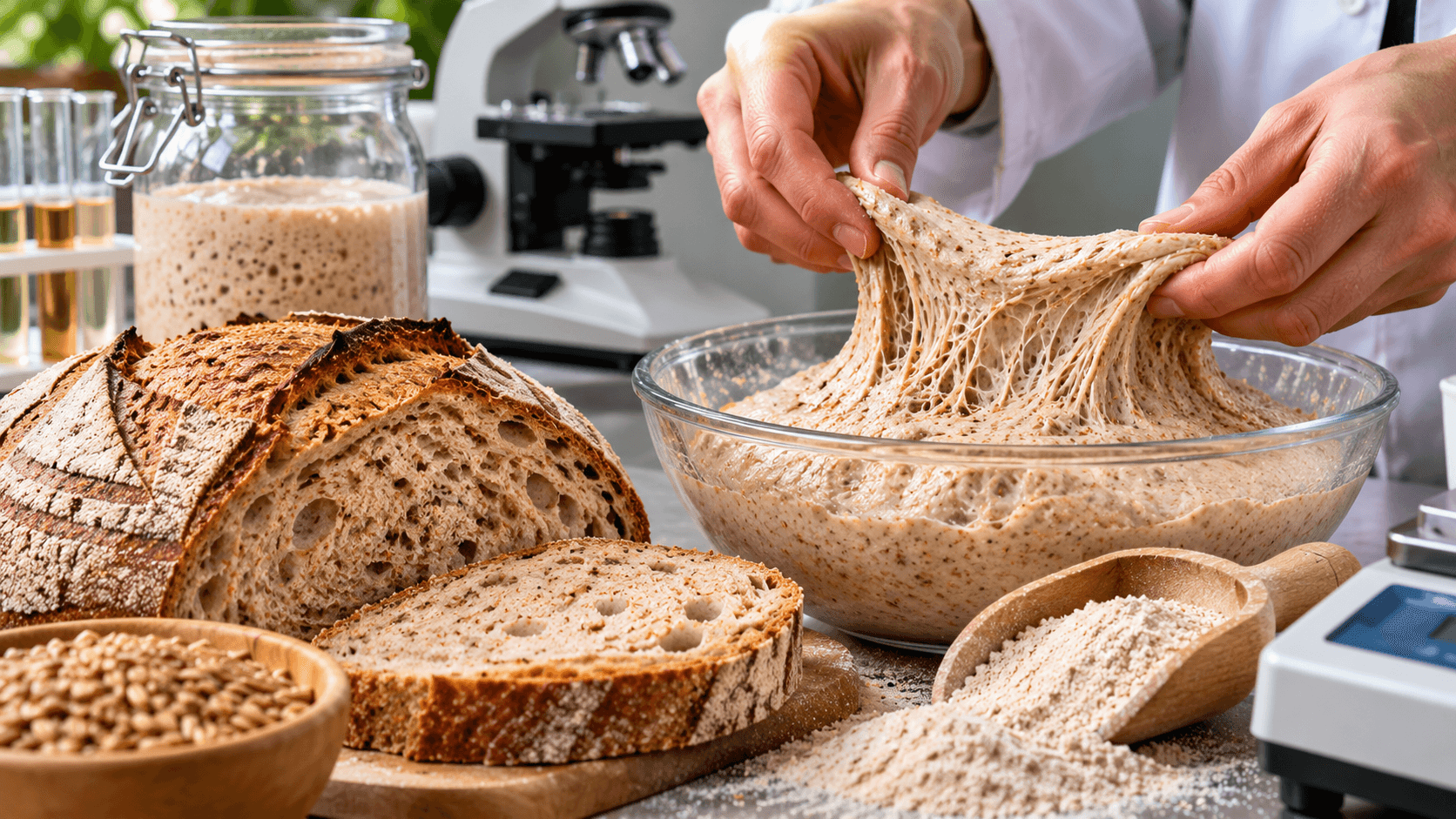 AI generated photo for American Sourdough Association. |
A simple two-bake experiment
For consistent starter care, keep your refreshment routine stable during the comparison.
How to read the results without overclaiming
A measured difference in metabolites tells us that fermentation conditions changed the dough's chemistry. It does not, on its own, tell us whether a loaf tastes better, is easier to digest, or improves health. Those questions need sensory testing, carefully controlled baking comparisons, or human studies, depending on the claim.
Why It Matters
Wholemeal sourdough research is moving beyond simple measures of acidity and volume. Molecular tools can reveal how microbial fermentation interacts with grain components, helping researchers formulate more precise questions about texture, flavor, and potential nutritional properties.
For bakers, the key distinction is between what scientists can measure in a laboratory and what a home loaf can demonstrate. Both are valuable, but they answer different questions.
The Takeaway
The new Food Chemistry research shows that selected bacterial cultures produce measurable changes inside wholemeal sourdough, including shifts in starch, protein, metabolites, and lipids. It does not identify a universally best starter or prove a health outcome.
Choose a reliable recipe, keep careful notes, and change one factor at a time. Let the science sharpen your curiosity, and let repeated bakes tell you what works in your kitchen. |
60 Comments
Join the conversation
A lab study can't tell me whether my next loaf will taste better, and that's fine. The difference between baking results and chemistry is worth knowing.
My starter gives a different flavor depending on the flour I feed it. I'd be curious whether those changes show up in the profiles they measured.
The small molecule measurements sound fascinating, though I had to read that part twice. I appreciate the plain explanation of what the researchers were checking.
I hope someone follows this with a home-baking test. It would be useful to see whether those bacterial differences show up in the finished bread.
I was hoping for a baking tip, but the lab findings are still worth reading. The changes in starch and protein surprised me.
The difference between molecular composition and loaf height is a good one to make. A tall loaf can still leave plenty of questions unanswered.
Daniel ChoExactly. I’ve had loaves rise beautifully and still turn out dense once sliced.
I usually call a batch ready once it doubles. This gives me a reason to pay closer attention to how the dough feels and smells too.
This explains why I should pay attention to more than the size of my wholemeal dough. Smell and texture have been useful clues for me too.
I would like to know which bacterial strains they used and whether any are common in home starters. Otherwise the findings feel a bit distant from my kitchen.
The careful wording about health benefits is welcome. I enjoy sourdough, but I do not need every loaf to come with a medical promise.
Wholemeal flour has so much going on compared with white flour. The mention of bran and germ helps explain why this study focused on it.
I am glad they measured protein structure too. Wholemeal dough can feel so different from white dough, even before it goes in the oven.
My starter gives a nice rise but a very sour loaf sometimes. The explanation about bacteria and acidity helps connect those two things for me.
Does a longer fermentation change these molecular profiles even more? That's what I wondered while reading about the starch and protein results.
Luis V.I wondered that too. It would be interesting to see the same dough tested at a few different fermentation times.
Does fermentation time affect those starch changes as much as the choice of bacteria? That seems like a question home bakers could use some help with.
As a home baker, I appreciate the honest limit on what this study can tell us. A lab result is not quite the same as a recipe test.
The graph analysis sounds impressive, though I would need a simpler explanation of what it showed. The difference between the bacterial strains caught my attention.
I like that the home baker takeaway is modest. It gives me something to think about without telling me to replace my starter.
Grace HollowaySame here. I’m curious about what my starter is doing, but I’m keeping it.
The point about yeast and bacteria working alongside each other is useful. I used to think the starter was doing one simple job.
I'd love to see a follow-up comparing these lab measurements with bread people actually bake. That would make the findings easier to picture.
It's nice to see a sourdough discussion that doesn't stop at whether the loaf got taller. The protein changes seem worth looking into.
Frank L.Agreed. I’d like to know what those protein changes mean for the finished loaf, if anything.
I keep a wholemeal starter and have noticed its smell changes before the dough looks much different. The acidity explanation makes sense to me.
The October study sounds thorough, but I'd be cautious about applying it straight to my kitchen starter. Home fermentation is pretty variable.
I would have liked a little more on which bacterial strains they tested. That's the detail that stood out to me.
The lipid changes are new to me. I knew fermentation affected flavor, but I hadn't considered that side of wholemeal dough.
I appreciate the careful wording around health benefits. Molecular differences are worth studying without promising more than the results show.
My wholemeal loaves can double and still come out dense. It's useful to be reminded that rise is only one piece of the puzzle.
I'd be interested to know whether the measured starch changes affect the finished loaf's texture. That's the part I'd notice at home.
The yeast making gas and the bacteria changing acidity is a clear way to put it. I finally understand why those are separate parts of fermentation.
Mike W.That helped me too. I used to think the rise told you pretty much everything.
I bake wholemeal sourdough most weekends and usually watch the dough more than the clock. It's interesting to think about the changes I can't see.
This explains why a good rise doesn't tell the whole story. I still wish there were a home baking test alongside the lab work.
The part about different bacterial strains producing different profiles surprised me. Now I'm wondering how much starters vary from kitchen to kitchen.
I hadn't thought much about the bran and germ during fermentation. Wholemeal dough always feels different to work with, so this caught my attention.
I'm glad the piece doesn't claim a particular starter makes healthier bread. The lab findings sound interesting, but that's a different question.
The distinction between loaf height and molecular changes is helpful. I tend to judge every batch by how much it rises.
I like the reminder that a doubled wholemeal dough is only showing us the rise. It makes me curious about what my starter is doing before I bake.
I have always watched for the dough to double before baking. Now I am wondering what changes I might miss when it gets there quickly.
I liked the point that wholemeal flour brings more than starch into the dough. Bran and germ must make this harder to study than white flour.
The selected bacteria part matters. My kitchen starter probably has a different mix, so I would be careful applying the results to every loaf.
This makes me want to keep better notes on my fermentation times. I know I cannot measure molecules at home, but I can track how my loaves turn out.
Sam W.I started noting room temperature along with fermentation time. It helped explain why the same timing gave me different results.
I would be curious to see the same measurements with ordinary supermarket wholemeal flour. That is what most of us are actually using.
The small molecules and lipids are new territory for me. I appreciate that the findings are explained without promising a healthier loaf.
My wholemeal loaves can double and still bake up dense. It is reassuring to see that rise alone is not a complete measure.
I wonder how much of these starch and protein changes carry through after baking. The dough is interesting, but I eat the finished loaf.
Marcus LeeI wondered that too. I’d love to see a follow-up that tests the baked bread, not only the dough.
The explanation of yeast making gas while bacteria change acidity makes sense to me. I finally understand why rising is only one part of fermentation.
I bake with wholemeal flour most weekends and had not thought much about the bran and germ during fermentation. That gives me something to read up on.
kim_87Same here. Wholemeal dough always behaves differently in my kitchen, and now I’m curious what the bran is doing while it rests.
Glad the piece says this was a lab study, not a nutrition trial. Sourdough gets enough health claims without adding another one too soon.
It is interesting that different bacterial strains produced different molecular profiles. I would love to know whether home bakers could notice any difference in taste.
You definitely can! Those different molecules translate directly into flavor—ranging from a mild, creamy yogurt tang to a sharp, vinegary punch or even subtle fruity notes. It’s one of the coolest ways to "tune" the flavor of your bread at home just by adjusting your flour or temperature!
The distinction between loaf height and what is happening inside the dough is useful. I have definitely assumed a bigger rise meant better bread.
I appreciate the reminder that a doubled wholemeal dough does not tell the whole story. I usually judge my starter by the rise alone.
I'm so glad that resonated with you! Judging by the rise alone is totally normal, especially when you're used to working with white flour. Wholemeal definitely plays by its own rules. Next time you feed it, keep an eye out for those tiny, lacy bubbles along the jar and a nice domed top—those are the real clues! 🍞✨