
Your freezer can pause a baking project, but it can also change the dough. A study published online November 1 examines whether selected sourdough bacteria can help preserve dough structure and bread quality during frozen storage.
The promising result is specific: one tested culture performed particularly well under controlled conditions. Before changing your own routine, read the study abstract and separate what the researchers measured from what a home baker can reasonably try.
At a Glance
What the Researchers Found
The paper reports that sourdough fermented with Lacticaseibacillus paracasei X11 helped preserve yeast viability and a more continuous dough network, with favorable bread texture and volume after frozen storage.
The important result is how the dough performs after thawing, not simply whether microbes survive. The reported measurements connect yeast viability with dough structure and finished bread characteristics. The research abstract identifies X11 as a promising treatment, but does not establish that a typical mixed starter will provide the same protection. |
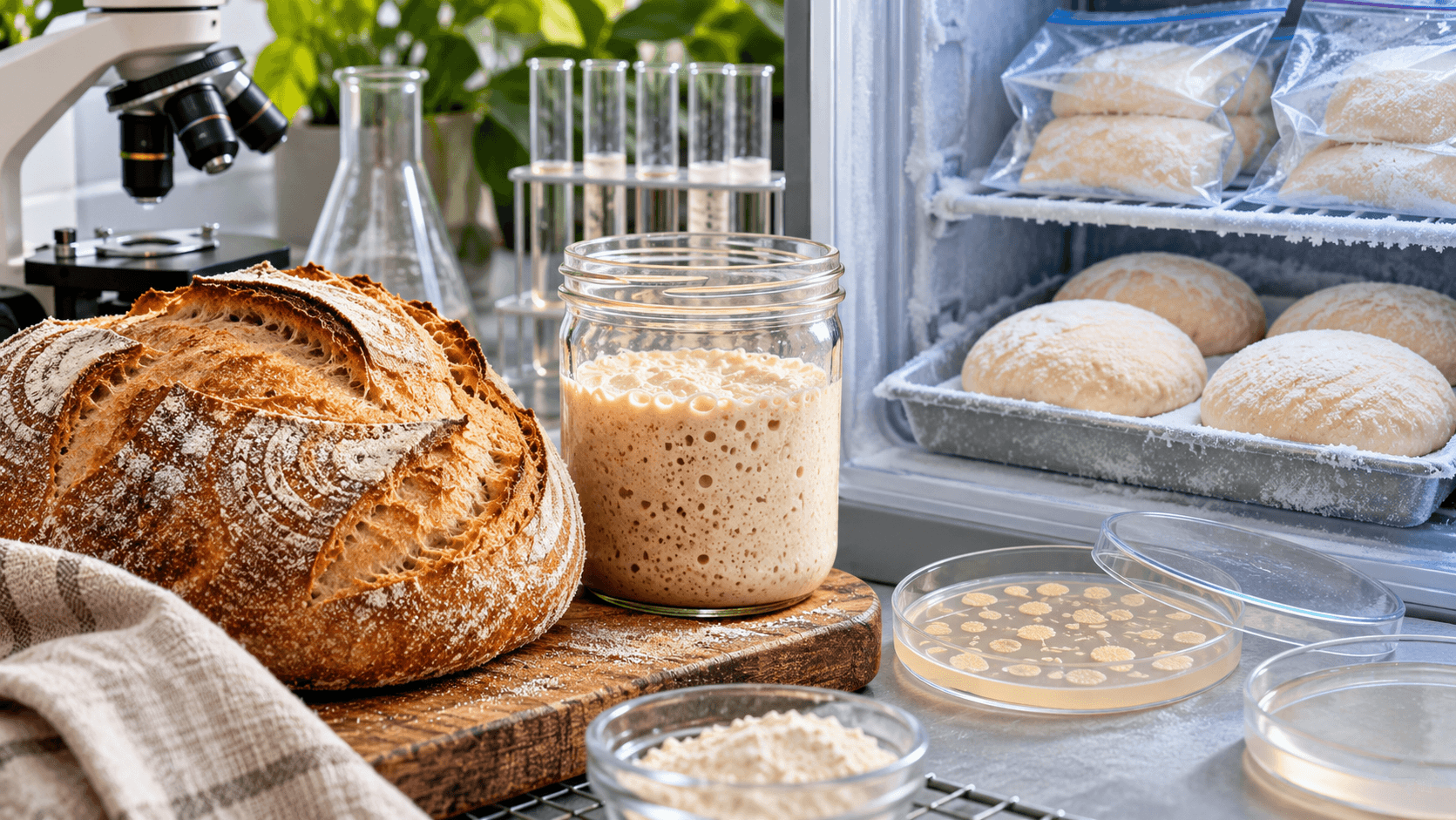
 AI generated photo for American Sourdough Association. |
Why Frozen Dough Behaves Differently
A dough contains more than flour and water. Fermentation changes its chemistry, and freezing changes how water and the dough’s structure behave. The study connects microbial activity with the quality of bread made after that interruption.
That is a process finding, not a claim that freezing improves all sourdough. The authors compared defined treatments. A home starter may contain a different microbial community, and a household freezer may not reproduce the experiment’s handling or temperature stability.
The abstract is enough to understand the main finding, but not enough to reconstruct the entire method. This guide therefore does not prescribe a culture dose, fermentation formula or guaranteed storage period from the paper.
For everyday baking, the King Arthur sourdough guide is a separate practical reference. Use a tested recipe to establish a reliable baseline before adding a new storage step.
Freezing raw dough and freezing baked bread are different experiments. Label them separately in your notes and avoid using the performance of one to explain the other.
As water freezes, ice formation and changes in the distribution of water can stress yeast cells and disrupt the dough network. During thawing, weaker gas retention or slower fermentation may show up as a flatter loaf or a tighter crumb. These are possible outcomes, not a diagnosis of every disappointing bake.
Some lactic acid bacteria produce compounds that can influence dough properties. The frozen-dough study is useful because it compares specific cultures rather than treating sourdough as one uniform ingredient. Strain identity and processing conditions matter. |
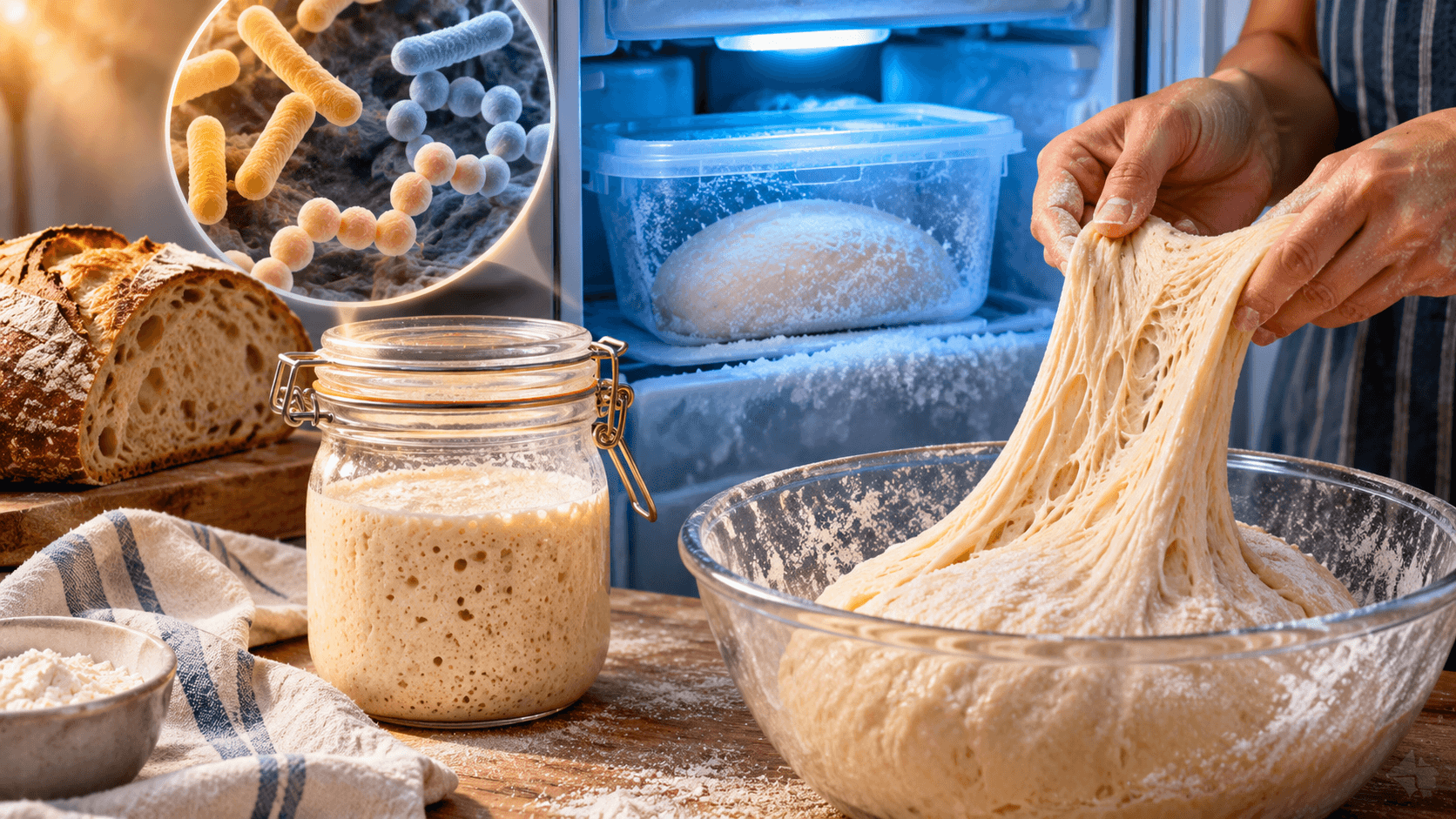
 AI generated photo for American Sourdough Association. |
Should You Freeze Dough or Baked Bread?
A baker who wants toast ready for busy mornings may find a finished-loaf storage routine more useful than freezing unbaked dough. Someone trying to divide preparation from bake day has a different goal.
The sourdough boule recipe provides one possible starting formula. Its timings should be read alongside your dough’s condition, starter activity and kitchen temperature.
A small test avoids committing a celebration’s entire bread supply to an unfamiliar method. Write down what you hope to learn: easier scheduling, acceptable texture or less waste.
A loaf that is convenient and enjoyable can be a successful result even if it differs from a freshly mixed comparison. Decide what matters before judging the outcome.
If your main goal is to keep bread fresh for longer, consider freezing cooled, sliced bread instead. The King Arthur baking resources offer practical storage and baking guidance. Wrap portions well, label the date and remove only what you need.
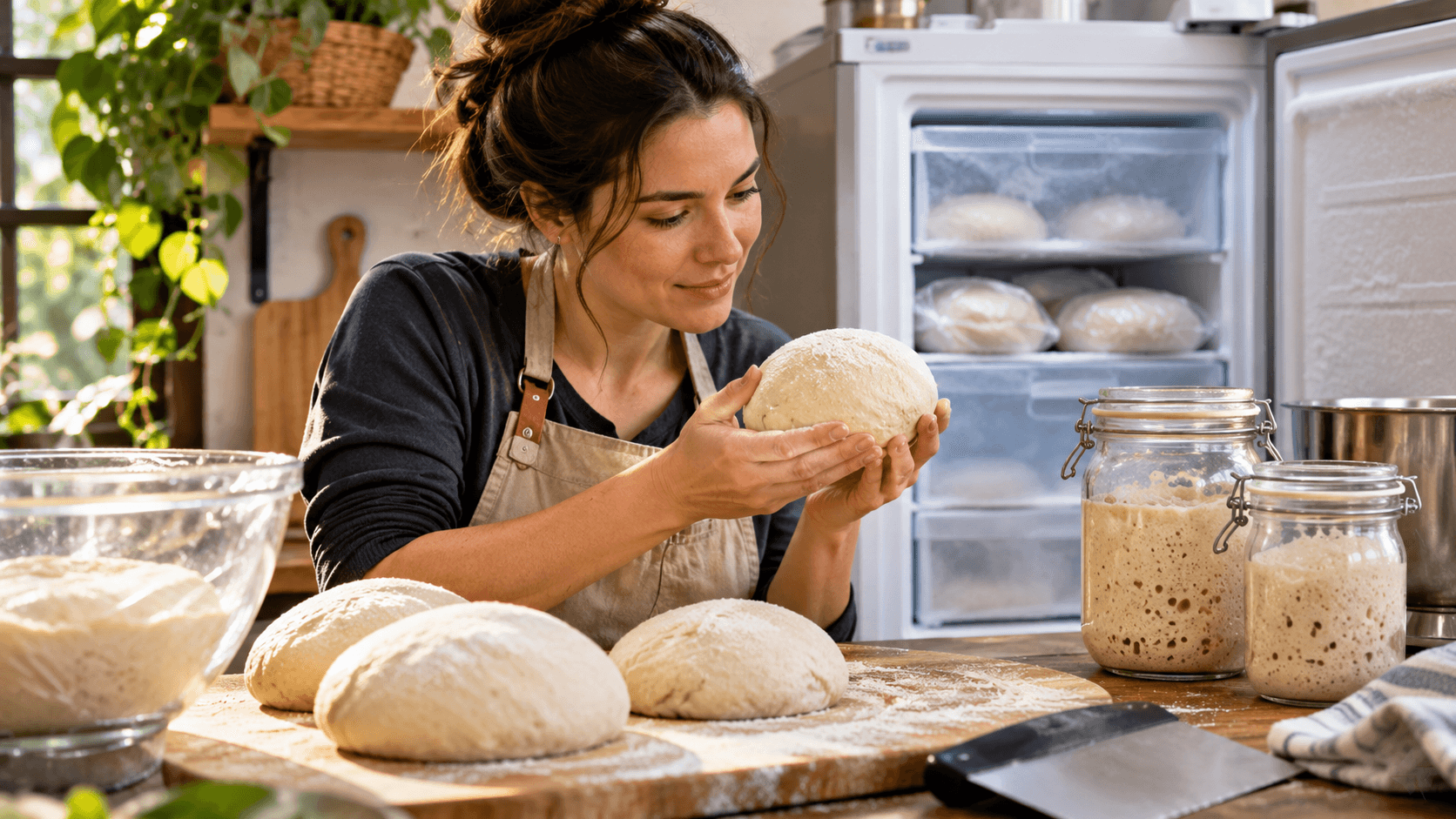
For raw dough, use a recipe with explicit freezing and thawing instructions if available. The USDA freezing guidance explains general food-storage principles. A freezer set to 0°F (−18°C) does not guarantee that dough quality will remain unchanged. |
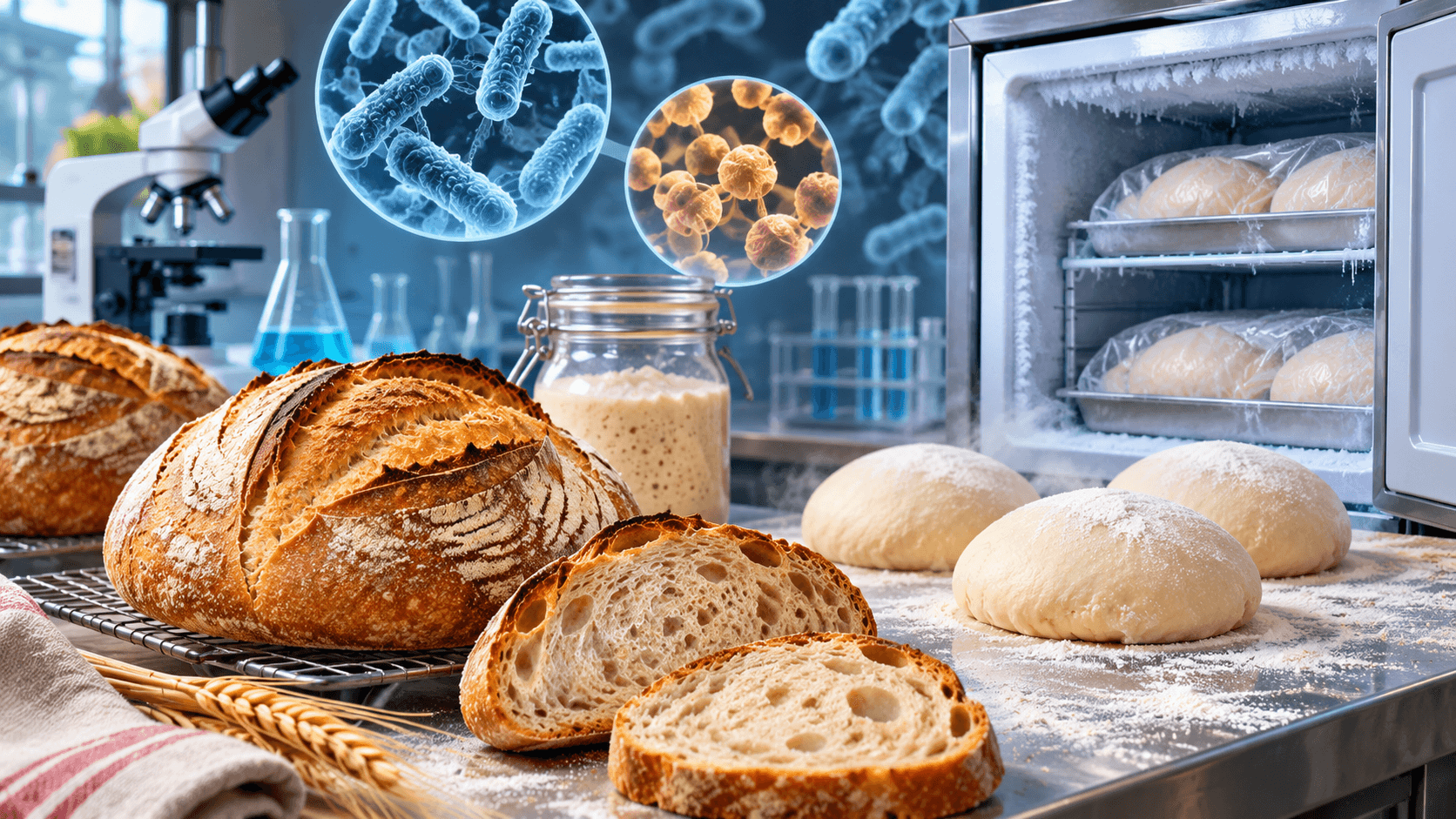
 AI generated photo for American Sourdough Association. |
A Small-Batch Freezer Test for Home Bakers
This is an observation template, not the research protocol:
Use the baking guide to troubleshoot the baseline, and return to the research record for the laboratory claim. They answer different questions.
Do not infer a health benefit from texture or yeast survival. The study concerns dough stability and bread quality; it does not demonstrate a clinical effect from eating the bread.
Nor does the finding justify adding an arbitrary probiotic supplement to a starter. A named organism in a paper is not a validated home recipe.
Look for results you can actually compare. Photograph the cut crumb after both loaves cool, note the rise and record how long each dough takes to become ready to bake. A slower thawed dough may need more time, but extra time alone cannot guarantee recovery of its structure.
Use the sourdough troubleshooting guide when the fresh loaf also performs poorly. Change only one major variable at a time. If both batches are weak, investigate starter activity, mixing and fermentation before blaming frozen storage.
The Takeaway
Selected sourdough cultures showed promise for protecting frozen dough quality. For home bakers, the useful lesson is to treat storage as a variable worth recording.
Keep a dependable recipe, test on a small scale and let the bread you actually bake guide the next adjustment. |
28 Comments
Join the conversation
I usually bake my extra dough right away and freeze the finished loaf. The thawed dough results are interesting, but I am not convinced I need to change that habit.
The name X11 sounds very specific, which helps keep the finding in perspective. I would enjoy seeing the same freezer test repeated with a few ordinary home starters.
I wonder if the bakery down the street freezes any of its sourdough dough. Their loaves are consistent, and this makes me curious about how they plan batches.
It is good to see finished bread quality included in the measurements. A lab result about surviving microbes alone would not tell me much about breakfast.
The practical question for me is whether I can freeze dough for a busy week without losing too much rise. This gives me a reason to try a small comparison.
I would be cautious about changing a recipe based on one culture doing well. The 28 day result is promising, but my starter and freezer are different.
I tried freezing sourdough dough once and got a heavy loaf. It is interesting that the researchers measured both the yeast and the dough structure afterward.
The controlled freezer temperature stood out to me. Mine gets opened constantly, and I wonder whether those temperature changes would affect the dough more than the starter.
My starter is a hand me down from a neighbor, so I have no idea which bacteria are in it. I am glad the home starter limitation was stated plainly.
It is encouraging that X11 helped preserve yeast viability. I would still like to know how the bread tasted, since volume is only part of the experience.
I wonder whether freezing the shaped loaf would give the same result as freezing dough earlier. That detail would matter a lot for my Sunday baking routine.
Sandra WellsI’d like to know that too. Freezing after shaping would fit my schedule much better.
This makes me want to label the date on my frozen dough for once. I usually guess how long it has been in there, which makes comparisons pretty useless.
I appreciate the careful wording around X11. The result sounds useful, but finding that exact culture for a home baking experiment seems unlikely.
The measured texture after baking is the part that interests me. A dough can look fine after thawing and still make a dense loaf.
I had never thought about the dough network when freezing sourdough. It explains why a thawed batch can feel different even when it still rises.
I have had better luck freezing baked loaves than freezing dough. These results make me curious, though I would want to see a home kitchen test before switching.
Ben CarterI freeze sliced baked loaves and toast what I need. It’s hard to beat that for convenience.
The distinction between a selected culture and a mixed home starter is important. Mine changes with the seasons, so I would not expect it to behave exactly like X11.
Rosa M.Same here. My starter is much more active in summer, so I’d be cautious about expecting the same results.
I bake for the weekend farmers market, and thawed dough can be unpredictable. A culture that helps yeast stay viable would be worth learning more about.
My freezer is small, so I rarely save dough. Still, the idea of protecting its structure could be helpful for bakers who prep several loaves ahead.
The three starter comparison is interesting. I would love to know whether the other two helped at all, even if X11 gave the best result.
I like that the researchers looked at the dough after thawing. Surviving bacteria sound promising, but I care more about whether the loaf has a decent crumb.
Twenty eight days at freezer temperature is a useful test, but I wonder what happens after two months. That is how long my forgotten dough usually stays in there.
The focus on bread volume makes sense to me. My frozen sourdough sometimes tastes fine but comes out noticeably flatter than a loaf made with fresh dough.
I appreciate the warning that my kitchen starter is not the same as the X11 culture. It is tempting to read a promising result and expect identical bread at home.
The 28 day freezer test caught my attention. I usually freeze extra dough for a couple of weeks, so I would be curious to compare the rise after thawing.