

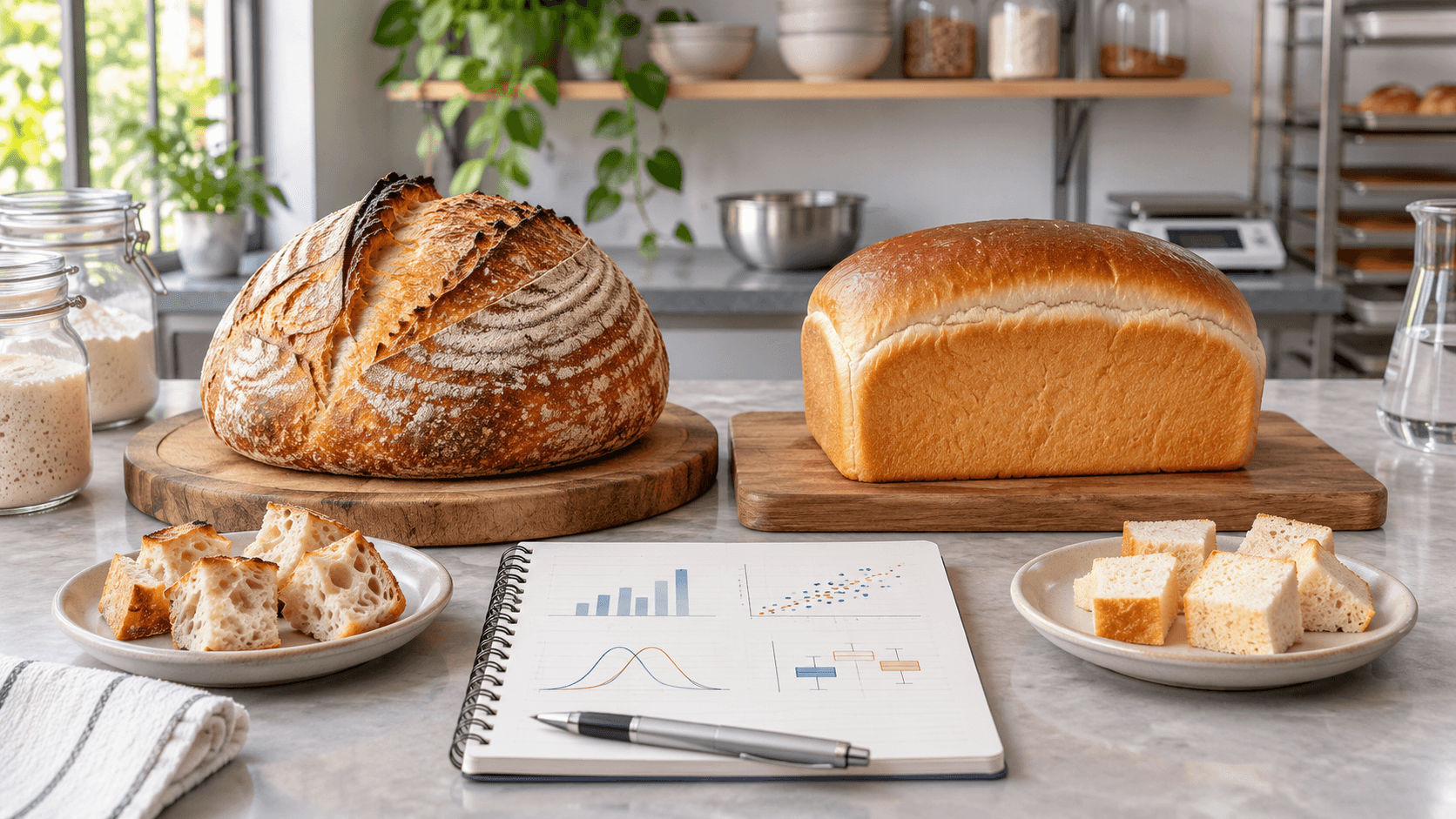
A small randomized trial found that some people reported fewer diarrhea symptoms after eating whole-grain sourdough bread than after a comparable baker’s-yeast bread. That is interesting, but it is not a universal prescription for every gut, every loaf, or every health condition.
The 20-person study enrolled healthy adults who reported mild to moderate symptoms after bread. Each ate one bread for a week, then crossed over to the other. The useful lesson for home bakers is curiosity with a firm grip on the limits.
At a Glance
|
 AI generated photo for American Sourdough Association. |
What the trial found
The study’s bread analysis found less fructose in the sourdough bread than in the baker’s-yeast bread. That matters because fermentable carbohydrates can affect some people’s symptoms.
Participants reported a statistically significant difference in the diarrhea sub-dimension, while the overall symptom score was borderline and did not meet the study’s threshold for statistical significance.
The researchers also reported changes in selected gut-microbe taxa after sourdough. That is a lead for further research, not proof that sourdough “fixes” a microbiome.
Individual responses varied. Some participants felt better with sourdough; others did not show the same pattern. |
 AI generated photo for American Sourdough Association. |
What it did not show
This was not a study of people with diagnosed celiac disease, wheat allergy, inflammatory bowel disease, or medically confirmed IBS. It was not a test of every commercial sourdough, every flour, or every fermentation schedule.
The overall result was not statistically significant. The sample was small, the intervention periods were short, and the authors describe the work as exploratory.
Do not use a promising bread study as a reason to ignore medical advice or reintroduce a food that has been medically restricted. The paper’s own limitations discussion is essential reading before drawing a personal conclusion.
How to use this research at home
Start with the methods and results, not a headline. This trial compared two specifically formulated whole-grain breads; it does not establish that every bakery sourdough will produce the same experience.
Keep the claim proportionate to the evidence. If you bake for yourself and do not have a medically restricted diet, try one familiar sourdough method, keep portions and meal context consistent, and note your response over time. A calm, repeatable comparison is more useful than chasing a label such as “easy to digest.” |
 AI generated photo for American Sourdough Association. |
Read the result in context
The participants ate each study bread for one week, then switched. That cross-over design helps researchers compare responses within the same person, but it cannot explain every reason a symptom may change from week to week.
It also matters that the breads were made to be broadly comparable in macronutrients. The reported difference in fructose content is one plausible detail worth noticing; it is not a shortcut to diagnosing a sensitivity or choosing a medically appropriate diet.
Questions to bring to a clinician
If symptoms are frequent, new, severe, or accompanied by weight loss, bleeding, fever, anemia, or persistent pain, baking experiments are not enough. A clinician can help decide whether testing, dietary guidance, or another evaluation is appropriate.
For people with celiac disease or a diagnosed wheat allergy, this small trial does not change the need to follow established medical advice. Traditional wheat sourdough still contains gluten unless it is made from appropriate certified gluten-free ingredients and handled safely.
The Bottom Line
This trial gives sourdough bakers a thoughtful clue, not a health promise. The sourdough bread was associated with a difference in one symptom sub-score and selected microbes, but the overall symptom result was not statistically significant. Bake with care, notice your own response, and involve a clinician when gut symptoms are ongoing or serious. |
31 Comments
Join the conversation
The difference in the diarrhea sub-score is worth a closer look. For now, I’ll keep baking what I enjoy and stay cautious about making health claims for it.
My family likes whole-grain sourdough for the taste, so the symptom finding is a bonus question for me. I’m glad it isn’t presented as a guarantee.
Clara V.Same here. We eat it because we like the flavor. I'd be curious whether anyone in the family notices a difference.
I wonder whether the people who felt better could tell which bread they were eating. With only 20 participants, those details seem especially important.
The home-baker takeaway feels sensible. I can try a loaf from my starter and pay attention, while remembering that my kitchen isn’t a controlled trial.
As someone who bakes both kinds of bread, I’d like to see the recipes. Whole-grain wheat can make very different loaves even when the basic nutrition looks similar.
Frank B.I'd like the recipes too. Fermentation time alone makes a big difference in the whole-grain loaves I bake.
One week on each bread sounds short to me. I’d be interested in a follow-up where people eat the loaves longer and keep the same symptom records.
I tried sourdough for stomach issues once and didn’t notice a difference. The small, specific result here fits my experience better than claims that it helps everyone.
It’s refreshing to see the limit stated plainly: fewer diarrhea symptoms for some people, no significant difference in the overall score. I can work with that.
I’m curious how long each sourdough loaf fermented. My kitchen gets cool in winter, and the timing of my own bakes changes quite a bit.
The similar macronutrients are a helpful detail. If one bread had been much richer than the other, I would have had a harder time understanding the comparison.
I buy whole-grain sourdough at the bakery, but I have no idea how they make it. This gives me a reason to ask about the loaf instead of trusting the label.
Twenty healthy adults with mild bread symptoms is quite specific. I hope nobody reads the diarrhea result as advice for someone dealing with a diagnosed gut condition.
Paul D.Agreed. Someone with a diagnosed condition should not take a small study like this as a reason to change their diet.
I wish the finding covered more than one symptom, but I appreciate knowing exactly what changed. That is more useful to me than a broad claim about gut health.
The crossover design makes sense when people can react differently to bread. Having each person try both loaves seems more helpful than comparing two separate groups this small.
My starter is ready most Fridays, so I may try paying closer attention to symptoms when I bake. I won’t treat one comfortable weekend as proof, though.
I like that both breads were whole-grain wheat. It keeps the comparison focused, though I’d also like to know whether a different grain would change the results.
Marcus J.Rye would be interesting to test next. I wonder if the grain or the fermentation would make more difference.
A week with each bread seems manageable for a home experiment. I’d still pay attention to what else I ate that week before blaming or praising the loaf.
My homemade sourdough varies a lot from loaf to loaf. That makes me cautious about assuming the bread in this study would behave like the one from my oven.
It helps to see that the overall GSRS-IBS score did not differ significantly. The diarrhea result sounds worth studying, but it’s a narrower finding than I expected.
The double-blind part surprised me. I can usually tell when a loaf is sourdough, so I’d be interested to know how similar the two breads tasted.
I’m glad the participants were people who already noticed mild symptoms after bread. I’d be curious whether the same pattern would show up in a bigger group.
I bake with a starter most weekends and have wondered whether the bread feels different afterward. Keeping track for a week sounds more useful than relying on memory.
The comparison with whole-grain baker’s-yeast bread caught my eye. I usually compare sourdough with plain white sandwich bread, which would tell me a lot less.
Comparing sourdough to white sandwich bread mixes up two different variables—refining and fermentation. Putting a whole-grain sourdough up against a whole-grain yeast loaf keeps the fiber and grain consistent, so you can actually tell what the slow fermentation is doing for your digestion. Excited to hear what you notice if you try that match-up!
Twenty people is a pretty small group. The result is interesting, but I would want to see a larger study before changing the bread I buy every week.
I appreciate the distinction between the diarrhea finding and the overall symptom score. It makes me curious to compare loaves at home without expecting sourdough to fix everything.
Thank you for reading so closely! That nuance is a huge takeaway—noticing specific shifts without expecting a cure-all keeps expectations realistic. Comparing loaves side by side at home is the best way to see what actually works for your gut. Enjoy the taste-testing!