

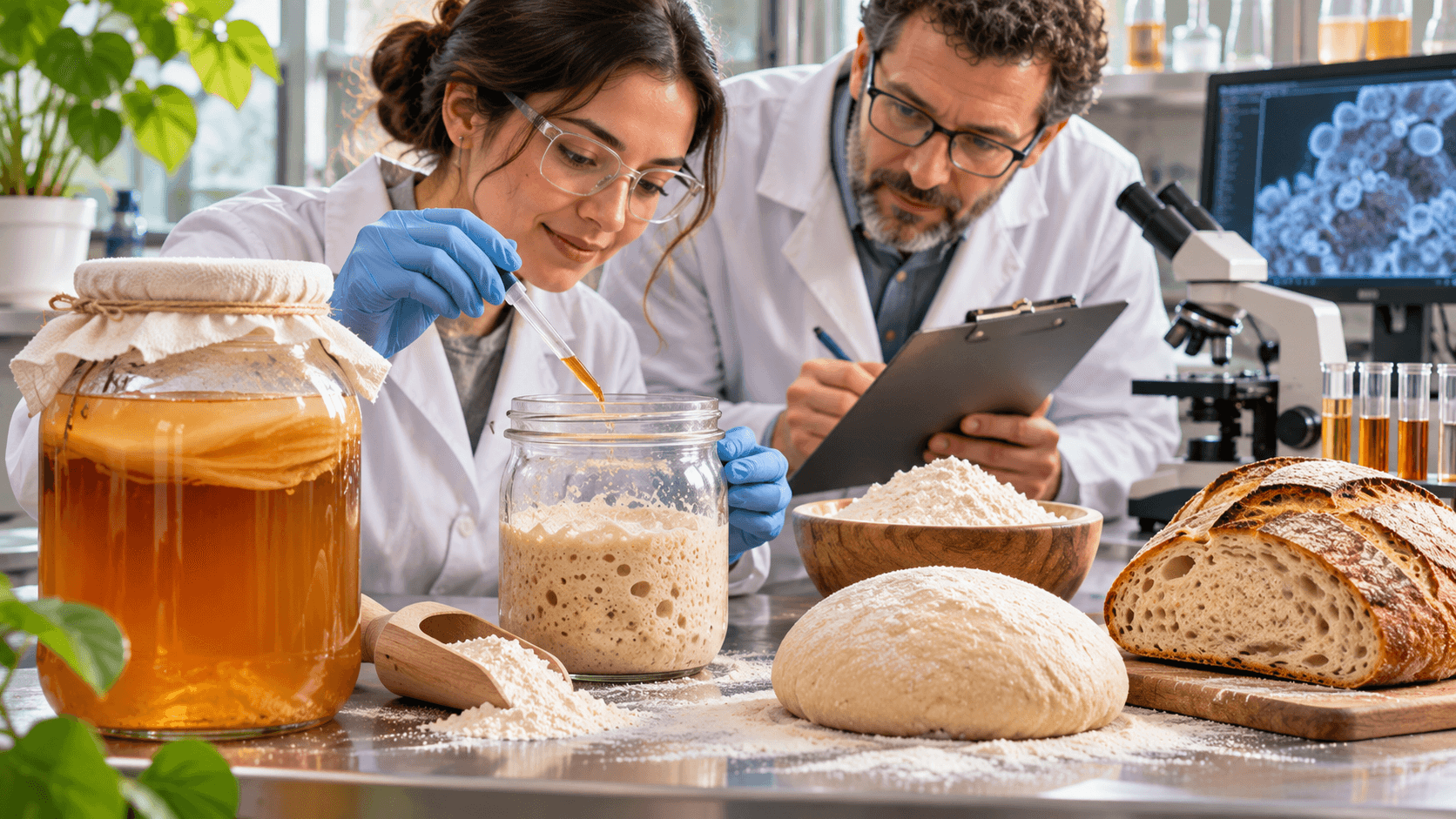
Could a kombucha culture help a baker establish sourdough faster? In a 2026 study, researchers used liquid kombucha to inoculate flour and developed a bread-ready sourdough in five days. The experimental loaves were comparable to conventional sourdough on key quality measures. That is an intriguing result for fermentation enthusiasts, but it is not a shortcut that has been validated for every kitchen or bottled kombucha.
At a Glance
What the KOMBREAD researchers actually tested
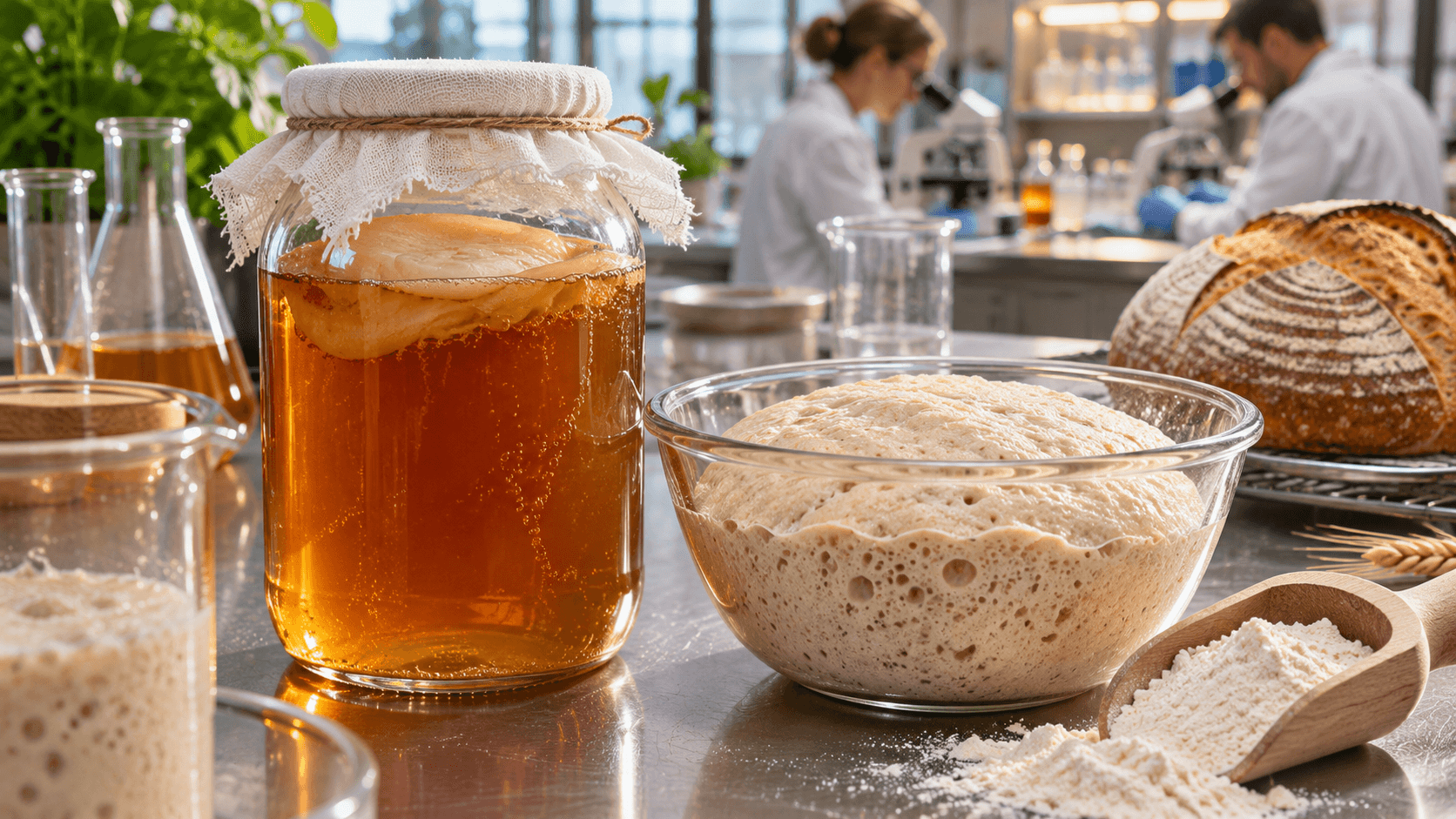
The full research paper describes a controlled fermentation experiment, not a test of bottled kombucha added directly to dough. The team prepared kombucha from black tea using an established culture and then used the fermented liquid to start a flour-based sourdough.
The distinction matters: kombucha supplied an initial microbial community, but the culture was subsequently maintained with flour and water. The comparison was with bread made using an established artisanal starter.
The study tested a refreshed sourdough system seeded with kombucha, not kombucha as a direct one-for-one replacement for a mature starter in a recipe.
|
 AI generated photo for American Sourdough Association. |
How the five-day starter was developed
The study's methods section outlines a five-day adaptation to wheat flour.
Those quantities describe the laboratory method, not a universally tested home-baking protocol. Commercial kombucha products may contain different live cultures-or few viable microbes.
What happened to the microbes?
The team measured yeasts, lactic acid bacteria, and acetic acid bacteria in the developed starter. By day five, yeast counts were not significantly different from the traditional control, while lactic acid bacteria were more abundant in the kombucha-based sourdough. Acetic acid bacteria were also prominent in the experimental culture.
The kombucha inoculum supported an active fermentation community. This does not mean every kombucha culture will develop the same microbial balance. The research discussion calls for more detailed microbial identification.
Did the bread rise and taste like sourdough?
Yes, within the limits of this comparison. The reported loaf-volume results were 2.621 cm³/g for kombucha bread and 2.456 cm³/g for traditional bread, with no statistically significant difference. Crumb structure, texture, and staling behavior were also comparable.
Preliminary sensory testing showed high acceptance. That is encouraging for bread quality, but the sensory assessment used untrained panelists and a relatively simple evaluation method.
|
 AI generated photo for American Sourdough Association. |
What the antioxidant results mean, and what they don't
The researchers reported higher total phenolic content and increased antioxidant capacity in the kombucha sourdough and bread. According to the study's discussion and results tables, the bread's total phenolic content was 0.66 mg GAE/g for kombucha bread versus 0.47 mg GAE/g for traditional bread, measured on a freeze-dried sample basis.
The researchers' discussion suggests tea-derived compounds contributed to the difference.
Higher antioxidant readings in a laboratory assay are not evidence that eating the bread improves health. Digestion and bioavailability remain untested questions. For bakers, the most immediately useful finding is that the alternative starter produced workable bread.
Why kombucha and sourdough aren't interchangeable
A conventional sourdough starter is maintained by repeated flour-and-water feedings. Kombucha begins with sweetened tea and a symbiotic culture of bacteria and yeast. Both rely on fermentation, but their nutrients, acidity, and microbial communities differ.
Repeated flour-and-water refreshments made the kombucha-seeded culture suitable for the tested bread formula. The KOMBREAD experiment does not establish direct substitution in other recipes.
Leavening requires more than acidity. Yeast activity, gas retention, dough structure, and fermentation conditions all affect loaf expansion. Sour flavor alone does not establish leavening power.
What limits the study?
The authors identified several important qualifications in their conclusion and limitations:
The findings support feasibility under controlled conditions, not universal reliability.
|
 AI generated photo for American Sourdough Association. |
A practical comparison for curious home bakers
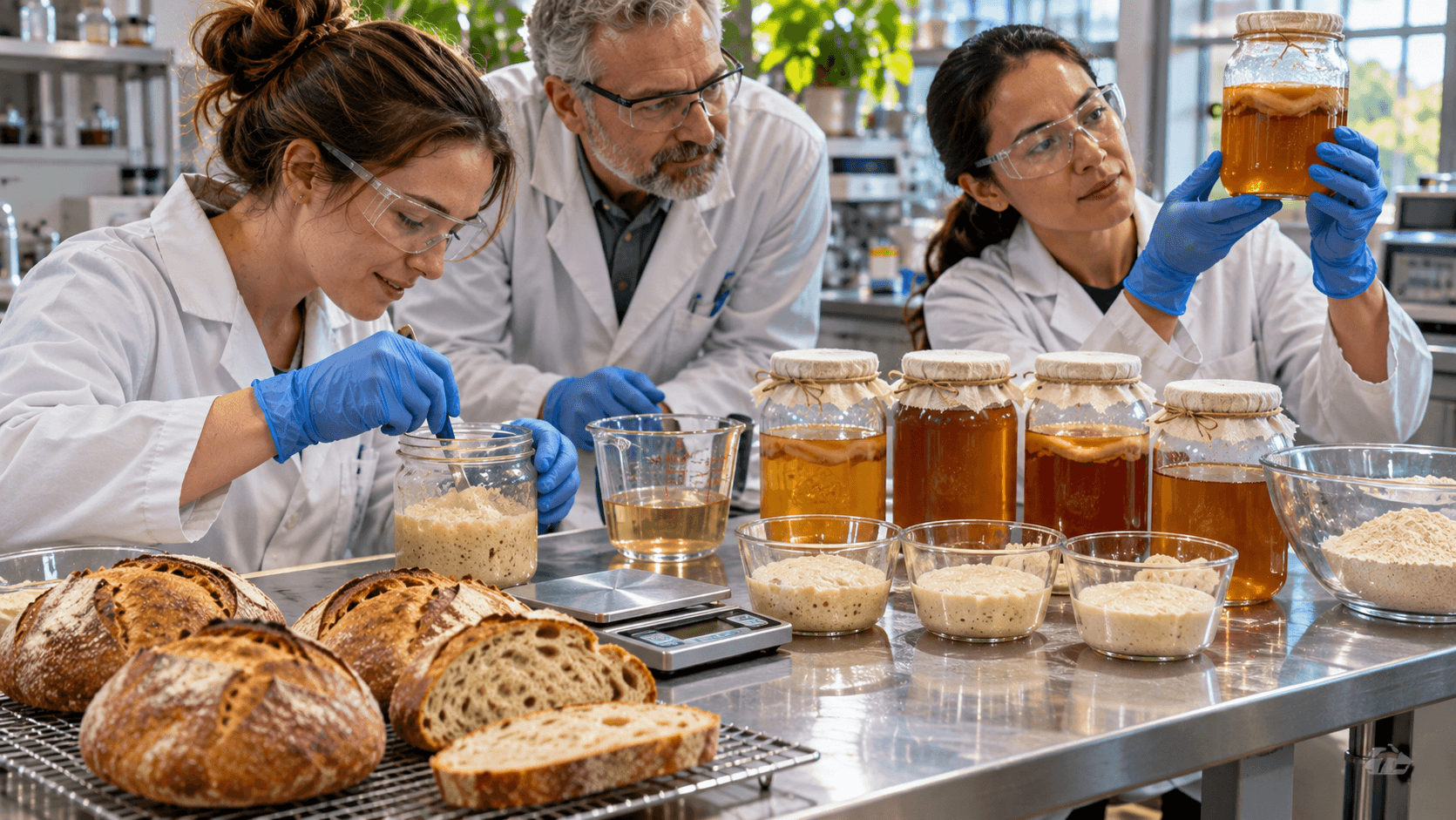
If you want to explore the idea, start by reading the published preparation method and keeping your regular mature starter as a control. The five-day timeline is not guaranteed with an uncharacterized culture.
For a useful side-by-side baking journal:
A controlled comparison is more informative than changing the culture, flour, hydration, and fermentation temperature all at once.
What researchers should test next?
Next studies should compare multiple cultures and flour types, with independent baking batches and more detailed sensory and microbial analysis.
Whether the phenolic differences have any nutritional effect remains unknown. \he Bottom Line
Yes, under the tested conditions, kombucha successfully seeded a sourdough culture that was ready for breadmaking in five days. Bread quality was comparable; laboratory antioxidant readings were higher.
The practical lesson is about fermentation technique, not a promised health upgrade or an instant starter. Read the KOMBREAD study, preserve a reliable control, and treat home experiments as experiments.
|
36 Comments
Join the conversation
I appreciate the reminder that higher antioxidant readings in a lab do not mean healthier bread. The faster starter is interesting enough on its own.
Robert L.Agreed. Getting a usable starter in five days would be plenty exciting for me, even without any health claims.
The antioxidant finding is interesting, but I am glad they did not call the bread healthier. I care more about whether it makes a good loaf.
kim_87Exactly. If it rises well and has a decent crust, that’s what would make me try it again.
I am happy with my old starter, so five days would not change much for me. It could be useful for someone starting over after theirs gets tossed by mistake.
kim_87My neighbor had to start over after someone cleaned out her fridge. Five days would have sounded pretty good to her.
A reliable old starter is hard to beat. A faster way to establish a new one could be most useful when someone is starting from scratch.
For anyone trying this at home, I would start with a small jar of flour rather than a whole batch of dough. Easier to see whether the culture takes.
Nina PatelA small jar would be easier to keep track of, too. I’d want to see it rising reliably before baking with it.
My first sourdough starter took well over a week to settle down. Five days sounds appealing, though I would still watch how it rises before baking.
The loaves being comparable in volume and crumb matters more to me than the antioxidant result. I would like to know how they tasted side by side.
The loaf volume and crumb results interest me more than the antioxidant numbers. A lab measurement does not tell me whether the bread is healthier to eat.
We agree. Loaf volume and crumb speak to baking performance. The antioxidant measurements were made in vitro and do not show that the bread is healthier to eat.
I wonder how the kombucha loaf tasted next to the one made with the established starter. Comparable sensory scores leave me curious about the flavor.
Leah M.Same here. I’d be curious whether the tea came through at all or if it just tasted like regular sourdough.
I would be cautious about trying this with bottled kombucha. The study used a prepared black tea culture, which could behave quite differently.
Dave ThompsonAgreed. Some bottled ones are pasteurized, so I wouldn’t expect them all to work the same way.
My first sourdough starter took more than a week to get going, so five days sounds appealing. I would still want to keep feeding it with flour and water before baking.
My first sourdough starter took nearly two weeks before it made a decent loaf. I might try a small batch with kombucha just to compare the timing.
That would be an interesting small-batch comparison. The five-day result came from a controlled culture, so a home batch may take a different amount of time.
Nina PatelI’d be curious how it compares. Would you use the same flour you used the first time?
Five days to a bread-ready starter is interesting. I appreciate the reminder that the researchers kept feeding it flour and water after adding kombucha.
I am curious how much the results depend on the black tea culture they used. A bottle from the grocery store might behave quite differently.
Priya N.I wonder about that too. Some bottles are pasteurized, so I would check the label before trying one.
I would like to see this tested with kombucha from the grocery store. A controlled black tea culture seems pretty different from what most home bakers have on hand.
We’d like to see that tested too. The study used kombucha prepared from black tea with an established culture, so its results cannot yet be assumed to apply to grocery-store bottles.
Five days to get a bread-ready starter is impressive. I appreciate that the researchers still fed it flour and water instead of pouring kombucha straight into the dough.
Exactly, the kombucha seeded a flour-based starter that was then maintained with flour and water. It was not poured into the dough as a replacement for a mature starter.
Maria G.Exactly. The kombucha gave it a starting point, but they still had to build up the starter with regular feedings.
The difference between using kombucha to start a culture and pouring it straight into dough is helpful. I might have tried the second one without that explanation.
Dave ThompsonSame here. I would have treated it like a liquid ingredient, but the flour and water feedings seem to be the key part.
If anyone tries this with kombucha from the local co-op, I would start with an unflavored one. I would still expect to feed the starter for several days, like the researchers did.
Joanne MillerUnflavored sounds like the best place to start. I’d check whether it’s live kombucha too, though a bottle might still act differently from what they used in the study.
Feeding the starter for several days is the important distinction here. The study did not test co-op kombucha, so even an unflavored bottle would be an experiment rather than a proven route to a five-day starter.
Five days to a bread-ready starter is impressive. I would like to try this with my own kombucha culture and see how the loaf turns out.
Maria G.If you try it, let us know how it tastes. I am curious whether any of the tea flavor comes through.