

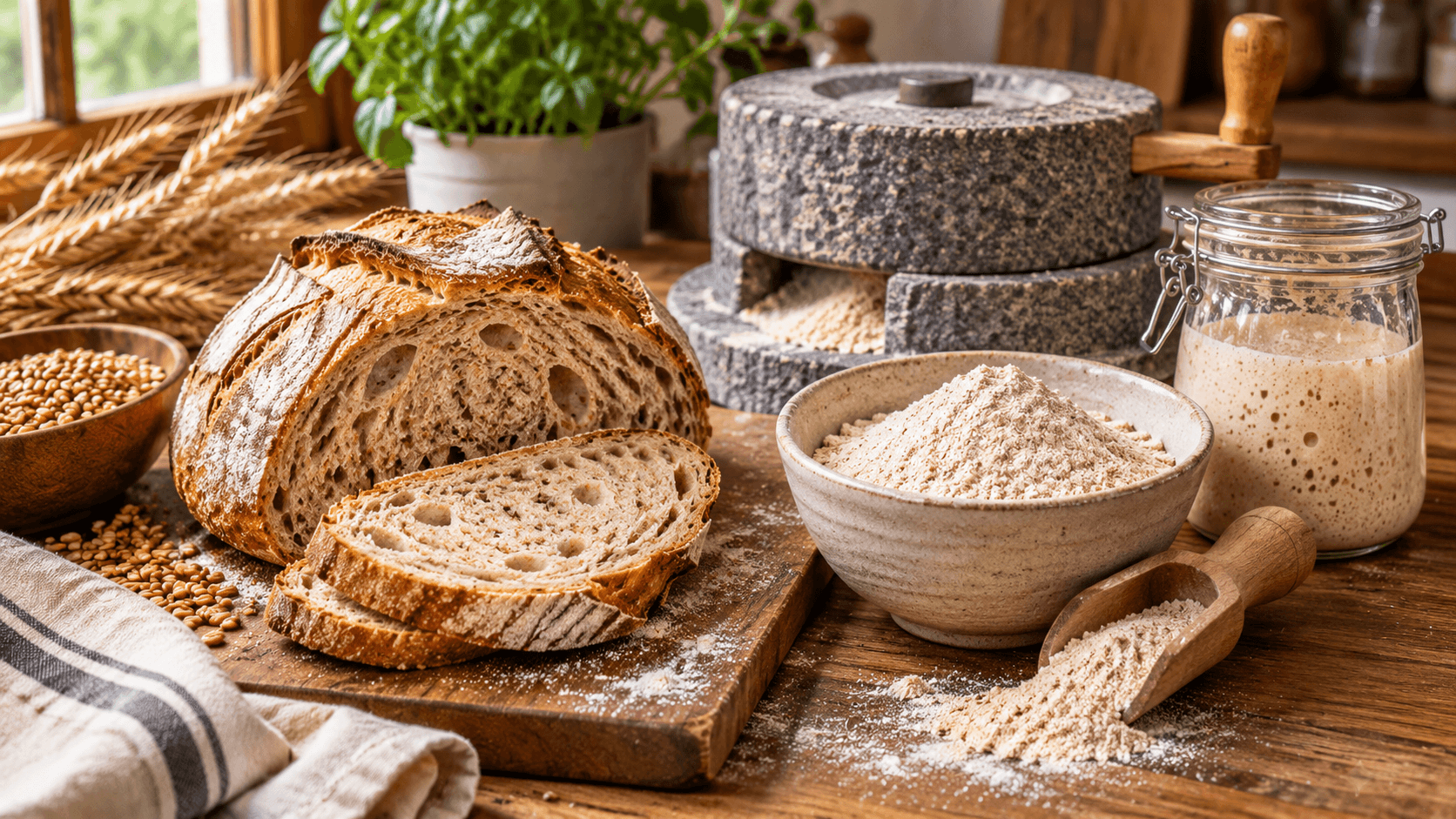
Does grinding whole-wheat flour finer actually make better sourdough? A 2026 food-science study suggests it can improve loaf volume and crumb softness, but only when the wheat and fermentation schedule work together. Flour fineness is one variable, not a universal shortcut to better bread.
Published October 15, 2026, in LWT, the open-access research paper tested whole-wheat flour made from several wheat classes, different stone-milling settings, and two fermentation durations. Its results offer home bakers a useful reason to pay attention to the grind of their flour, not just the protein percentage on the bag.
At a Glance
What the researchers actually tested
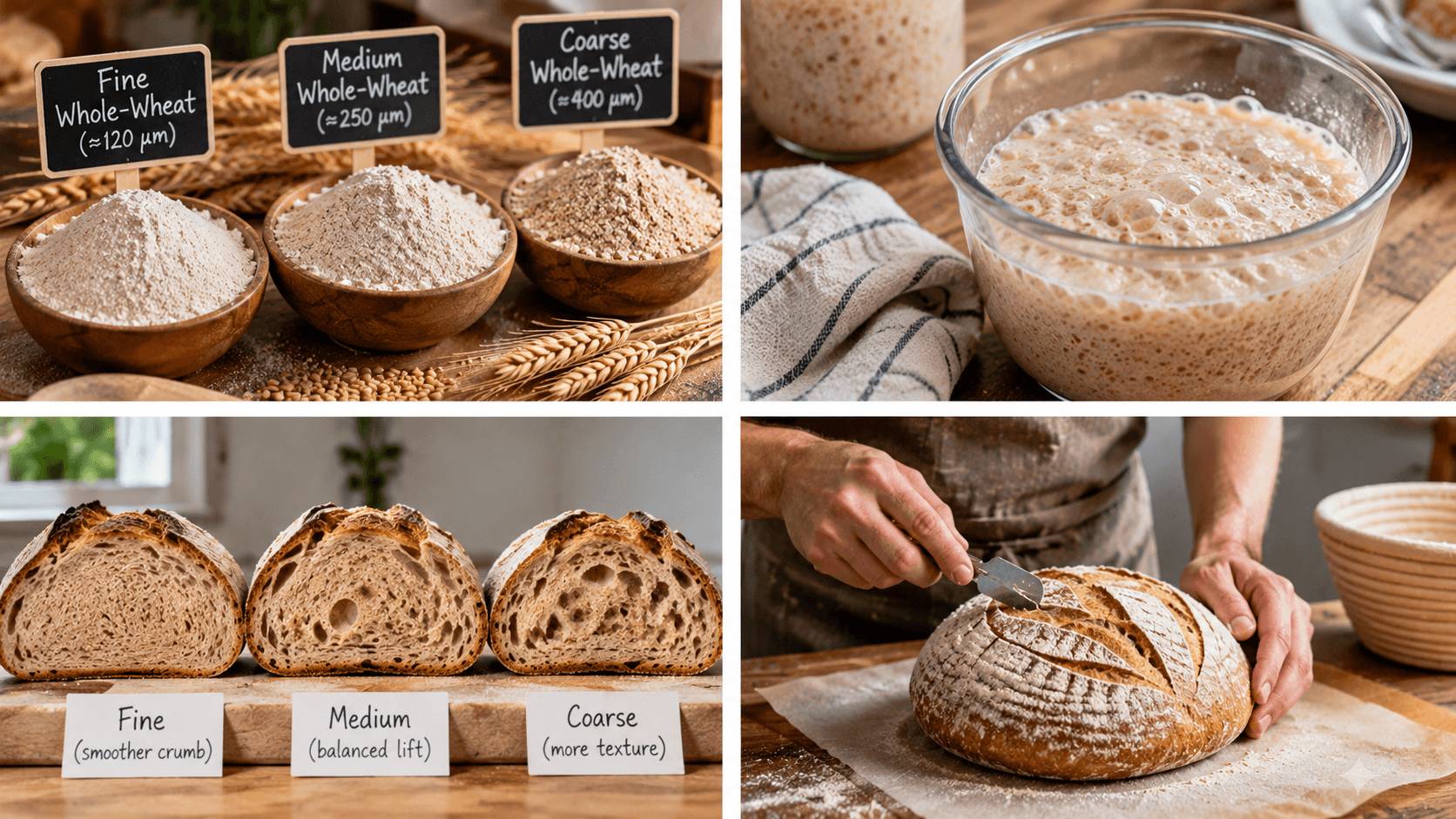
Researchers Md Ahmadul Islam, Jiajia Rao and Shahidul Islam compared hard red spring (HRS), hard red winter (HRW) and hard white wheat (HWW), as well as 50:50 blends containing HRS. They stone-milled the grains using wide, medium, and narrow mill gaps, then examined flour and dough properties before evaluating the resulting sourdough breads.
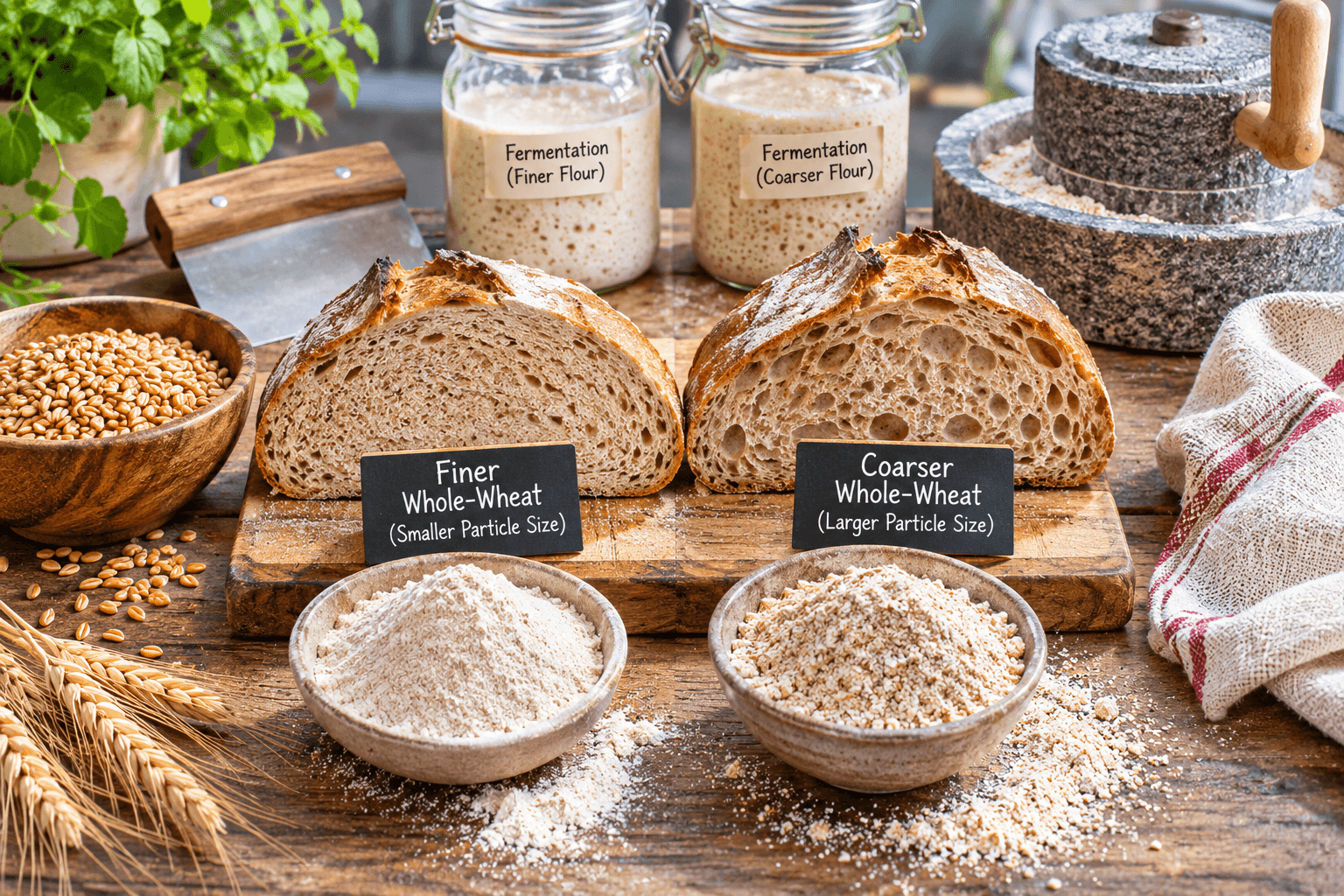
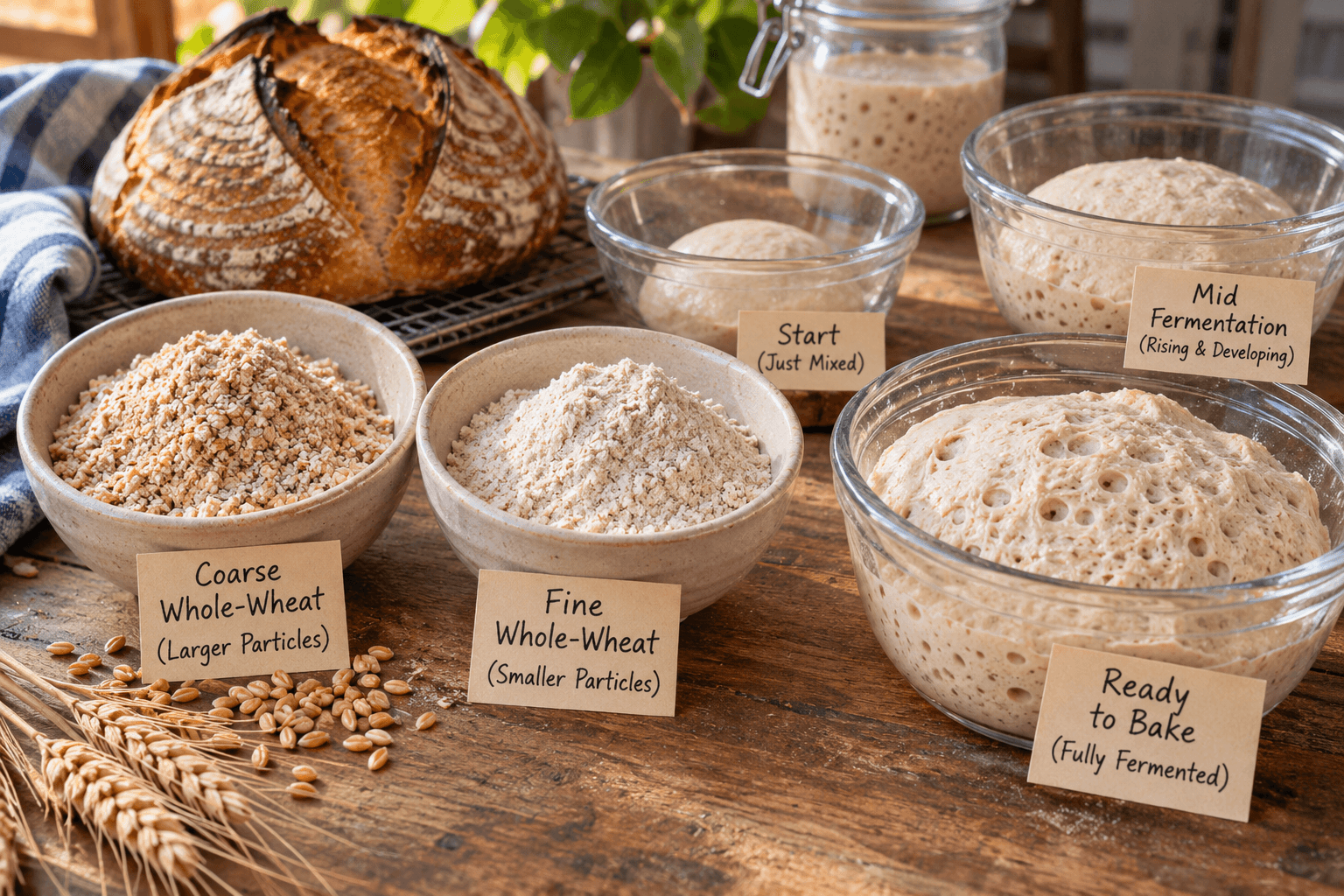
The study abstract and results report both 12-hour and 24-hour fermentation conditions. This matters: changing the flour's particle size while ignoring fermentation can miss a major part of the result.
Think of flour grind, wheat selection, and fermentation time as a connected system. A finer grind may change dough handling and crumb, but it cannot compensate for every difference in wheat or fermentation.
|
 AI generated photo for American Sourdough Association. |
The numbers: finer flour helped volume and softness
Across the study's tested conditions, reducing particle size was associated with a 13.48% increase in bread volume and a 23.23% reduction in hardness. These are experimental findings from the researchers' formulations, not a promise that every home loaf will rise 13.48% higher.
The researchers also observed improved mixing tolerance and crumb-cell stability with finer flour. The results align with a broader body of work showing that particle size influences how whole-grain flour behaves in dough. For example, a 2017 study of whole-wheat steamed bread found differences in dough stability and finished crumb when flour particle size changed.
Why wheat class mattered
The strongest dough was not automatically the best finished bread. Hard red spring wheat showed strong dough characteristics, but blends with hard red winter or hard white wheat offered a more balanced combination of strength and extensibility.
The 2026 researchers reported that blending 50% hard red spring wheat increased measured mixing stability for hard red winter flour from 5.64 to 8.05 minutes and for hard white wheat from 5.48 to 8.60 minutes. Those numbers come from laboratory dough measurements rather than suggested mixing times for a home recipe.
The practical point is balance. Dough that resists mixing strongly is not necessarily the dough that gives the most pleasing sourdough crumb.
|
 AI generated photo for American Sourdough Association. |
A two-loaf experiment for your own kitchen
You do not need a laboratory mill to explore the question. Find two whole-wheat flours with different grinds, ideally from the same wheat type and producer. The closer the ingredients are, the easier it is to notice the effect of particle size.
For a cleaner experiment, change only one variable at a time. If you alter the flour, hydration and starter all at once, it becomes difficult to tell what caused the difference.
What to record
If one dough seems noticeably stiffer or thirstier, make a note rather than quietly adding extra water during the first comparison. You can run a second bake with adjusted hydration to see which flour performs best in a recipe tuned to it.
The American Sourdough Association takeaway
Finer whole-wheat flour can improve sourdough structure, but the grain and fermentation schedule still matter. The 2026 LWT study found larger, softer loaves under some finer-grind conditions while also showing that longer fermentation changed the trade-offs.
For home bakers, the most useful next step is not buying the finest flour available. It is comparing flour grinds thoughtfully, keeping notes and adjusting the recipe to the flour in front of you. Better bread comes from understanding the ingredients as a system.
|
 AI generated photo for American Sourdough Association. |
A two-loaf experiment for your own kitchen
You do not need a laboratory mill to explore the question. Find two whole-wheat flours with different grinds, ideally from the same wheat type and producer. The closer the ingredients are, the easier it is to notice the effect of particle size.
For a cleaner experiment, change only one variable at a time. If you alter the flour, hydration and starter all at once, it becomes difficult to tell what caused the difference.
What to record
If one dough seems noticeably stiffer or thirstier, make a note rather than quietly adding extra water during the first comparison. You can run a second bake with adjusted hydration to see which flour performs best in a recipe tuned to it.
The American Sourdough Association takeaway
Finer whole-wheat flour can improve sourdough structure, but the grain and fermentation schedule still matter. The 2026 LWT study found larger, softer loaves under some finer-grind conditions while also showing that longer fermentation changed the trade-offs.
For home bakers, the most useful next step is not buying the finest flour available. It is comparing flour grinds thoughtfully, keeping notes and adjusting the recipe to the flour in front of you. Better bread comes from understanding the ingredients as a system.
|
45 Comments
Join the conversation
The main lesson for me is to write down both the flour and fermentation time. Otherwise I will never know what made a loaf softer.
I like the reminder that a finer grind is not a guaranteed fix. Changing one thing at a time has taught me more than changing my whole recipe.
Joanne FieldsSame here. I started writing down my proof times, and it made the flour changes a lot easier to judge.
My whole-wheat loaves often turn out heavy despite a strong starter. It is encouraging to have a specific flour change to test.
I can test this with my own starter by keeping the wheat and timing the same. Changing only the grind should tell me more.
A 24-hour fermentation is a big commitment for my schedule. I am curious whether the finer flour helped much at 12 hours too.
Finer flour improving volume makes sense, but I would still keep some coarse flour around. I enjoy a heartier slice with soup.
Felix GrantSame here. A coarse whole-wheat loaf holds up better when I dunk it in soup.
I wish there were a simple way to compare particle size on flour bags. Most of the whole-wheat brands at my grocery store do not say.
I appreciate that the researchers tested actual sourdough breads after measuring the flour and dough. The finished loaf is what matters in my kitchen.
This makes me want to label my flour jars more carefully. I keep hard white and hard red wheat, then forget which loaf used which.
It is useful to hear that protein percentage is not the whole story. I have bought high-protein flour and still ended up with a heavy loaf.
Frank R.I've had that happen too. Did you give that flour the same fermentation time as your usual one?
The 50:50 blends caught my attention. I already mix two whole-wheat flours, so I might keep the blend steady and change only the grind.
I would love to see photos of the crumb from each wheat type. Softness is easier for me to judge when I can see the slices.
The comparison between 12 and 24 hours is useful. My schedule often decides how long a loaf ferments before flour choice does.
I have had fine whole-wheat flour make a sticky dough, so loaf volume is not my only concern. Handling matters for home bakers too.
I would still start with the wheat I like the taste of. A taller loaf is nice, but flavor matters more to me than a soft crumb.
The narrow mill gap sounds promising, but I would like to know whether it makes stone milling much slower at home.
The three stone-mill settings are an interesting detail. I wonder whether sifting a coarse flour would give a home baker anything close to the finer grind.
I am glad they tested hard white wheat too. It is the one I usually buy, and it does not bake quite like hard red in my kitchen.
Softer crumb would be a win for our sandwich loaves. I wonder if the difference is as noticeable after the bread sits overnight.
Comparing 12 and 24 hours makes sense to me. My dough behaves very differently when I leave it overnight, even with the same flour.
My local mill sells several grinds of whole wheat. This gives me a good reason to buy small bags and bake them side by side.
I like that the takeaway has a limit. A finer grind may help, but I still need to watch the dough during fermentation.
Paul D.Yep, the clock only tells me so much. I still check how much the dough has risen.
The 50:50 blends interest me most. Blending might be easier for my kitchen than trying to find one perfect whole-wheat flour.
Hard red spring and hard red winter have never baked quite the same for me. I am glad the study did not treat all wheat alike.
I tried grinding wheat twice once, and the loaf was noticeably softer. I did not keep my fermentation time steady, though, so now I wonder.
It would be helpful to know how much extra water the finer whole-wheat flour needed. That tends to be where my dough gets tricky.
I usually check protein percentage and stop there. The point about particle size gives me another thing to look for when buying flour.
My last 24-hour sourdough was much too sour for us. I would probably test the finer flour with the 12-hour schedule first.
The three stone-mill settings make this more useful than a simple fine versus coarse comparison. I wish my home mill had clearer settings.
A bigger loaf sounds nice, but I also like the texture of coarser whole-wheat bread. I would want to compare the flavor.
I use hard white wheat because my family likes the milder taste. Now I am curious whether a finer grind would soften the crumb too.
I appreciate the reminder that finer flour is not a guaranteed fix. Wheat type seems worth tracking alongside grind size.
Nina PatelI started writing the wheat type on my flour jars. It makes comparing batches a lot easier.
The 12-hour and 24-hour comparison caught my eye. My dough behaves very differently after a full day, even with the same flour.
Dave ThompsonDoes yours get stickier by the 24-hour mark? Mine does, especially when the kitchen is warm.
I have been blaming my starter for dense whole-wheat loaves. I may try a finer flour before changing my feeding routine again.
My whole-wheat sourdough sometimes comes out dense even when the starter is active. I had not thought to check how coarse the flour is.
I would like to know how much softer the finer-ground loaves were. A small difference might not be worth changing how I mill flour.
Dave ThompsonI'd want the actual numbers too. If it's barely noticeable, I'd rather keep my mill setting where it is.
The point about flour grind and fermentation working together is helpful. I can try a finer flour without assuming it will fix every loaf.
Maria G.That seems like a good way to test it. Keep the wheat and timing the same, then see if the finer grind helps.