
You pull a fragrant, crackling sourdough loaf from your oven and wonder whether it is actually healthier than the packaged one at the store. Homemade bread gives you control over flour, salt and fermentation. But a commercial loaf can offer just as much, or more fiber, depending on its recipe. The useful question isn't simply “homemade or store-bought?” It's “what's in each loaf, and how was it made?”
Before your next bake or grocery run, use this simple test: compare two loaves by equal weight, whole-grain content, fiber, and sodium. Then decide whether fermentation method or ingredient control matters most to you.
At a Glance
1. Start With the Flour, Not the Sourdough Label
A white-flour homemade sourdough may be delicious, but it can have less fiber than a packaged whole-wheat bread. The USDA's MyPlate guidance recommends making at least half your grains whole grains, because whole grains retain more of the grain's original components.
Try this: Compare a white-flour sourdough with a loaf made from whole-wheat or rye flour. Check how much whole grain is actually used rather than relying on a rustic crust or dark crumb. For packaged bread, read the ingredients list and look for whole-grain flour near the beginning.
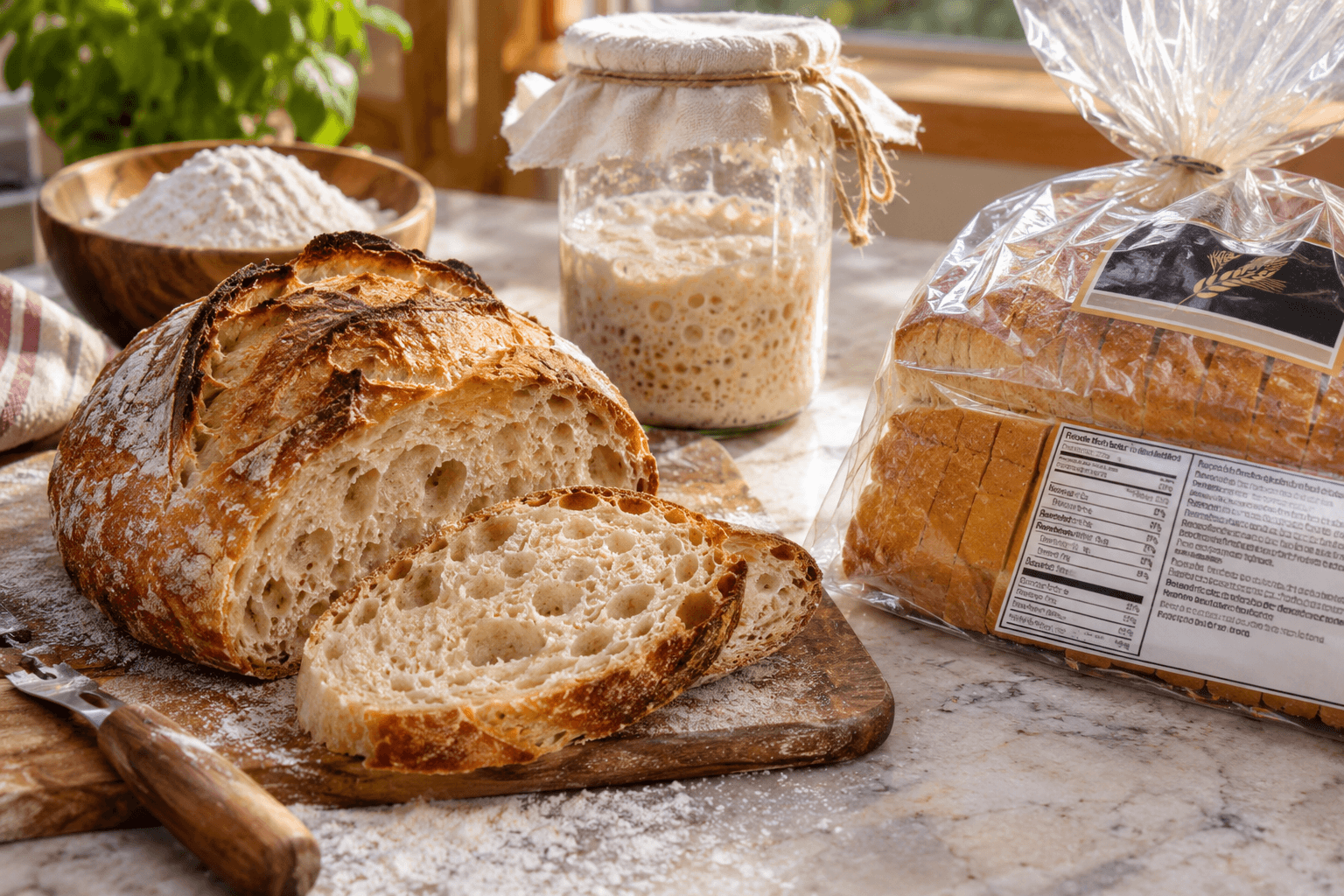
“Homemade” describes where bread was baked, not its fiber content. For a more meaningful choice, compare whole-grain percentages and fiber per 100 grams of bread. The whole-grain guidance is a useful starting point. |
 AI generated photo for American Sourdough Association. |
2. Does Long Fermentation Make Sourdough More Nutritious?
Traditional sourdough relies on yeast and lactic-acid bacteria living together in a starter. During fermentation, they produce acids and transform components of the dough. Bakers can explore the process in this sourdough guide.
Research suggests sourdough fermentation can reduce phytate under some conditions. Phytate can bind minerals, so reducing it may improve mineral availability in certain doughs. However, results depend on the flour, microbes, acidity, and fermentation conditions. See the published research on sourdough and phytate.
That does not mean every long-fermented loaf delivers more minerals to the body. A change measured in dough is not the same as a demonstrated health benefit in people eating ordinary portions.
Commercial sourdough varies too. Some bakeries use long fermentation; others combine sourdough flavor with commercial yeast or added acids. The label alone may not tell you the complete process. If fermentation method matters to you, ask the bakery how the loaf is made. A label that says “sourdough” does not, by itself, establish how long the dough fermented or which microorganisms were used.
For bakers: A longer bulk rise does not automatically mean more nutritional benefit. Keep fermentation consistent for flavor and dough performance, then evaluate nutrition separately from crumb structure and sourness.
3. What About Blood Sugar?
Some studies find differences in glucose responses to sourdough compared with other breads, but findings are mixed and depend on the recipes and study design. Research reviews on sourdough and glycemic response are a better starting point than claims that sourdough “prevents blood sugar spikes.”
Flour refinement, fiber, portion size, and the rest of the meal can affect glucose response. A thick slice of white sourdough is still a carbohydrate-rich food. People managing diabetes should follow individualized advice rather than assume sourdough is automatically a low-glycemic choice. Compare the carbohydrate content on the Nutrition Facts panel and account for the amount actually eaten. |
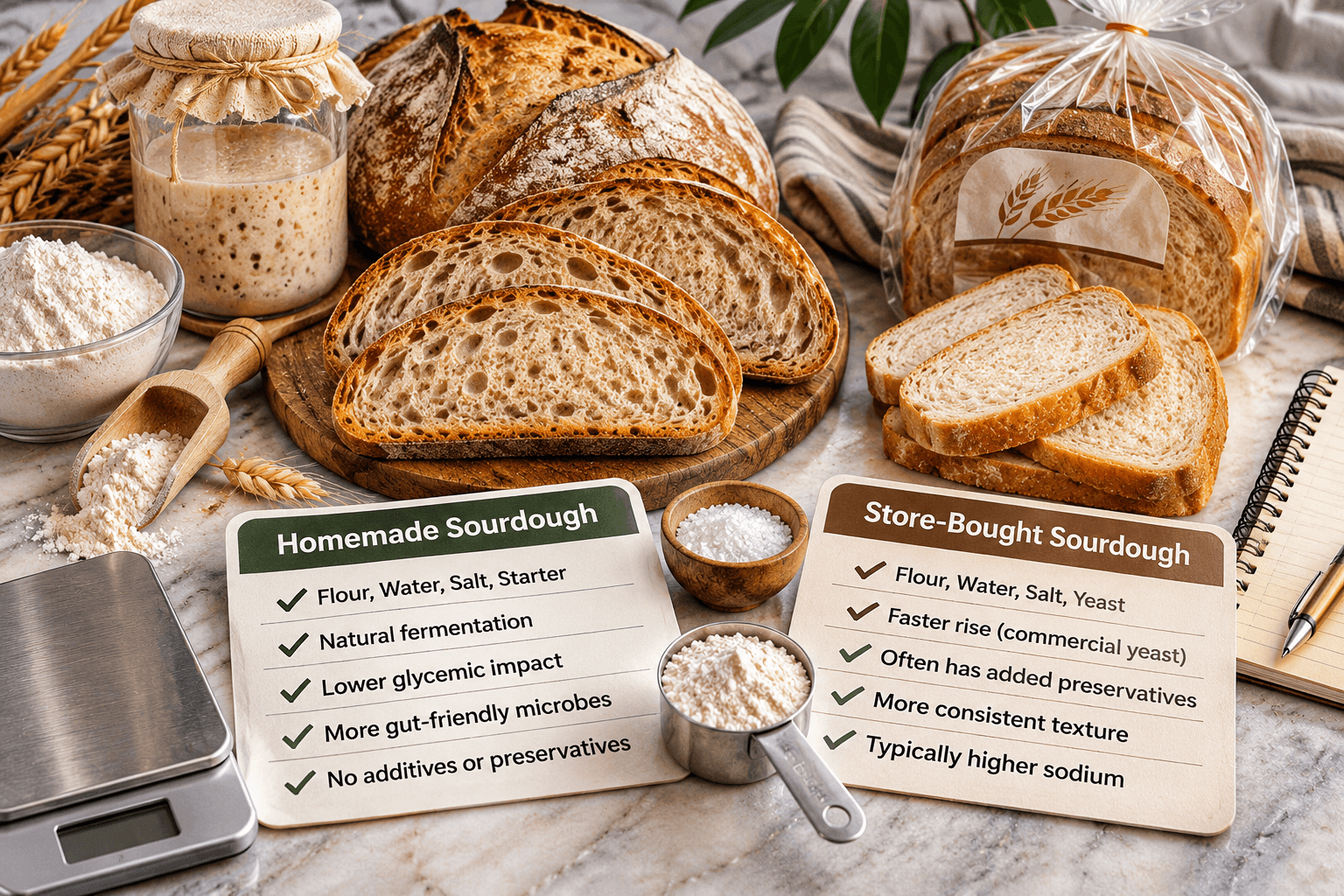 AI generated photo for American Sourdough Association. |
4. Sodium Is Easy to Overlook
Salt supports flavor and dough structure, but it also contributes sodium. At home, you can weigh the salt in your formula. For packaged bread, the Nutrition Facts panel lists sodium per serving, making comparisons more straightforward.
For example, a dough with 500 grams of flour and 10 grams of salt contains 2% salt by flour weight. That is a baker's percentage, not a claim that each slice contains 2% salt. The sodium per slice depends on loaf yield and slice weight. For a simple home estimate, 10 grams of table salt contains roughly 3,900 milligrams of sodium in the entire dough; divide by the number of equal portions after baking. This is an estimate, not a laboratory nutrition analysis.
Read the FDA's sodium guidance when considering overall intake. If you want to reduce salt in a homemade recipe, make changes deliberately: salt also influences fermentation and dough handling.
Quick calculation: If your loaf is divided into 16 equal portions, the estimated 3,900 mg sodium from 10 g salt works out to roughly 244 mg per portion, before accounting for sodium in other ingredients. Weigh the finished portions if you want a closer comparison with packaged bread.
5. “Few Ingredients” Doesn't Always Mean “Healthier”
A classic homemade loaf may contain just flour, water, starter and salt. That simplicity can be appealing, especially if you prefer to avoid certain added ingredients. But food additives are not automatically harmful, and a short ingredient list cannot tell you how much fiber or sodium a loaf provides.
Commercial breads may include added oil, sweetener, seeds, whole grains or nutrients. Those additions can change texture and nutrition in different directions. Use the FDA's label-reading guide to compare actual amounts, not just the length of the ingredient list.
Ask two separate questions: Do I like these ingredients? And does this loaf meet my nutrition goals? They are related, but they are not identical.
6. Is Sourdough Easier to Digest?
Some people report that particular sourdough loaves feel easier to eat. Fermentation can change certain carbohydrates, but the effect varies widely with the flour, starter, and process. Personal experience does not establish that all sourdough is easier to digest than all other bread.
Wheat sourdough still contains gluten. Ordinary sourdough fermentation does not reliably remove gluten to levels safe for celiac disease. The guidance explains why standard wheat sourdough should not be treated as gluten-free.
For someone who needs gluten-free bread, choose a product made and labeled for that requirement rather than relying on the word “fermented.” The FDA's gluten-free labeling standard provides a more reliable basis for packaged-food decisions. |
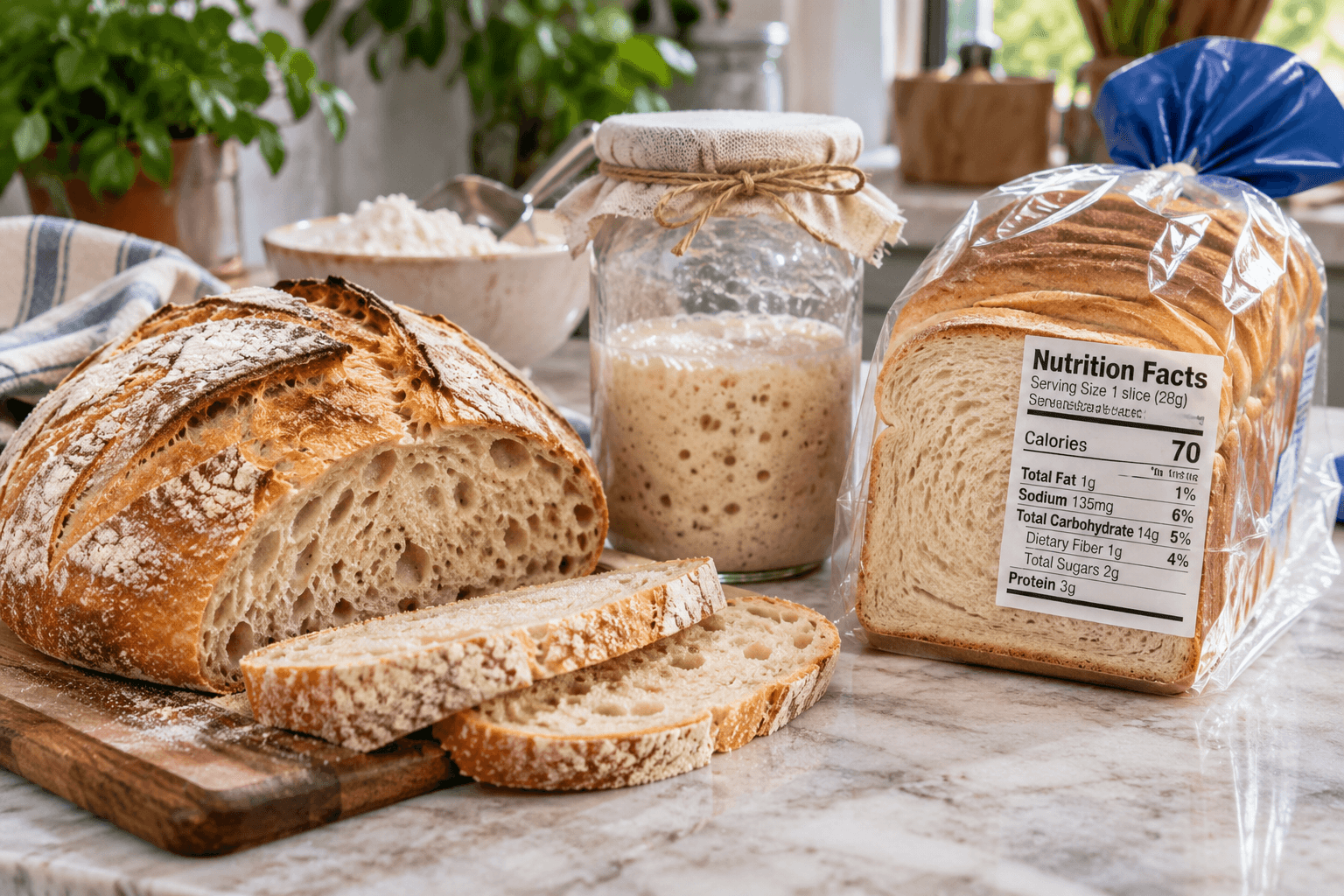 AI generated photo for American Sourdough Association. |
7. A Practical Homemade vs. Store-Bought Comparison
Instead of comparing two random slices, start with the same weight of bread. A thick homemade slice can be substantially heavier than a thin packaged slice. The USDA FoodData Central database can help estimate nutrients for basic ingredients, while packaged loaves provide their own label values.
Baker's notebook tip: Record total flour, whole-grain percentage, salt, starter amount, bulk-fermentation time, and final loaf weight. For a fair comparison, keep slice weights similar, ideally 100 grams of each loaf, or two portions weighed on the same scale. King Arthur's sourdough resources can help you document a repeatable process.
Three Questions Bakers Often Ask
The Bottom Line
Homemade sourdough offers control, not an automatic nutritional upgrade. A useful next bake is to substitute part of the white flour with whole-wheat flour, keep a written formula, and compare the finished loaf's texture and portion size with a store-bought whole-grain option. A whole-grain store-bought loaf may offer more fiber than a homemade white sourdough. A carefully formulated homemade loaf may let you choose whole grains and manage salt more precisely.
The strongest comparison comes from ingredients, nutrition information, realistic serving sizes, and the evidence on fermentation. Bake for flavor and enjoyment, then choose flour and portions that fit your needs. |
29 Comments
Join the conversation
The celiac warning is especially important when sharing homemade bread. I would rather ask about someone's needs than assume fermentation made my loaf safe.
The rye suggestion has me interested. I have only baked white sourdough so far, and trying another flour sounds like a good weekend project.
I appreciate that the advice does not tell everyone to stop buying bread. A good whole-grain loaf from the store works for our household.
I never noticed how different the slice weights can be. My bakery sourdough slices are almost twice as big as my sandwich bread slices.
A Nutrition Facts label is handy when I am in a rush. I can compare two store loaves much faster than I can calculate my recipe.
Whole-wheat flour changes my sourdough dough quite a bit. I would love more tips on adding it without ending up with a dense loaf.
Molly ChenI started by swapping in a quarter whole-wheat flour and adding a little more water. The loaf stayed much lighter that way.
I have seen sourdough described as a cure for all sorts of things. The cautious wording about fermentation feels more useful than another big claim.
Greg P.I appreciate that too. I like sourdough, but it helps to know what fermentation can and can't do.
The distinction between homemade and whole grain is worth making. My grandmother baked wonderful white bread, and nobody would have called it high fiber.
Comparing equal weights is sensible, though I usually care more about whether my family will eat the bread. Fiber matters little if it goes stale.
I used to buy the darkest loaf on the shelf and call it healthy. Checking the first flour listed sounds like a better habit.
I make a half whole-wheat sourdough, and it is still plenty good with soup. You do not have to use all white flour.
The salt point caught my attention because my family watches sodium. Being able to adjust a recipe is a real advantage for us.
I wish more recipes listed how much whole-grain flour they use. That would make the suggested comparison easier for people baking at home.
The packaged whole-wheat loaf in my kitchen has quite a bit of fiber. I used to assume baking at home would always beat it.
Kimberly N.Same here. My homemade white loaf tastes great, but the whole-wheat one I buy has more fiber.
Does anyone know an easy way to estimate fiber in a homemade loaf? I can weigh the flour, but the comparison still takes some figuring.
I am glad the fermentation claim is kept in perspective. I enjoy sourdough, but I have heard too many promises about blood sugar.
Looking for whole-grain flour near the start of the ingredients list is a useful grocery tip. Some bread labels make it hard to tell.
I would still choose my homemade sourdough for the taste. It is good to know that does not automatically make it the higher-fiber choice.
My starter makes a lovely loaf, but I have been using mostly white flour. I might try adding rye and see how the texture turns out.
The whole-grain percentage seems like the key detail here. A dark crust has fooled me into thinking a loaf was whole wheat before.
I like having control over the salt when I bake at home. Next time I shop, I will check the sodium on my usual loaf too.
Checking fiber per 100 grams makes more sense than comparing slices. The serving sizes on bread packages can be all over the place.
Ben AlvarezExactly. One brand's slice is nearly twice as thick as another's, so the package numbers can be misleading.
I appreciate the clear warning about celiac disease. People sometimes assume a long fermentation makes regular wheat sourdough safe, and it does not.
I bake sourdough most weekends and usually use white flour. I had not thought about how a whole-wheat store loaf might have more fiber.
The reminder to compare bread by equal weight is helpful. My homemade slices are much thicker than the packaged ones I buy.