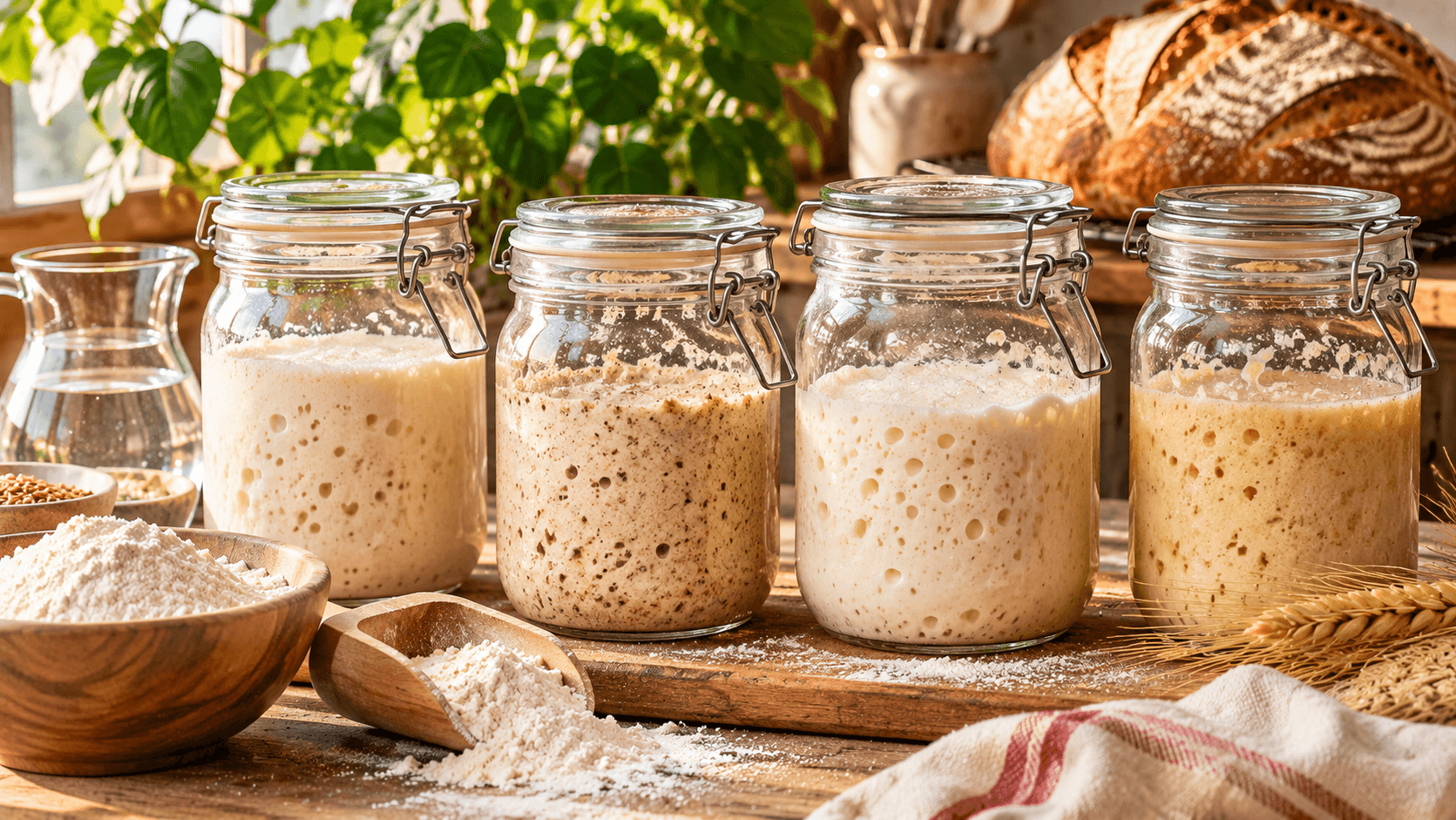
Does your starter smell fruity while your baking friend's smells more like yogurt? Even two jars fed from the same mature culture can develop different aromas as their flour and fermentation conditions change. Instead of chasing the perfect smell, try a small comparison that tells you something useful about your own baking routine.
You only need two clean jars, a kitchen scale and your usual sourdough starter. The goal is to discover whether a flour change makes a noticeable difference without putting your next loaf at risk.
At a Glance
Why Two Starters Can Smell Different
Yeasts and lactic acid bacteria produce a range of fermentation compounds as they consume nutrients. Flour composition, temperature and feeding intervals can influence the resulting aroma. Research into traditional Chinese sourdough examines microbial communities alongside flavor compounds, but you cannot identify individual microbes from the smell of a home starter.
Your nose is useful for noticing changes, not diagnosing the microbial community. Pair aroma observations with the visible changes described in a sourdough baking guide. |
 AI generated photo for American Sourdough Association. |
Set Up a Small Flour Comparison
Choose a mature starter that is rising reliably with your regular feeding routine. Keep a separate backup untouched so that the experiment does not interfere with your bread plans. Use identical clean food-safe jars with room for expansion and loosely fitted lids.
Jar A, white flour: Mix 10 grams of mature starter, 20 grams of water and 20 grams of your usual white bread flour.
Jar B, whole wheat flour: Mix 10 grams of the same starter, 20 grams of the same water and 20 grams of whole wheat flour.
Both jars have the same feeding ratio by weight. Mark their starting levels, label the flour and place them together at a stable, comfortable room temperature. Do not add extra water to one jar even if its texture differs; this comparison deliberately keeps water quantity constant.
Whole wheat may absorb water differently from white flour. The texture can affect how bubbles appear and how much the mixture expands, so rise height alone is not a precise measurement of microbial activity.
Think of this as a kitchen observation, not a controlled microbiology experiment. The quantities are a suggested home-baking setup, not a recipe tested in the published research. |
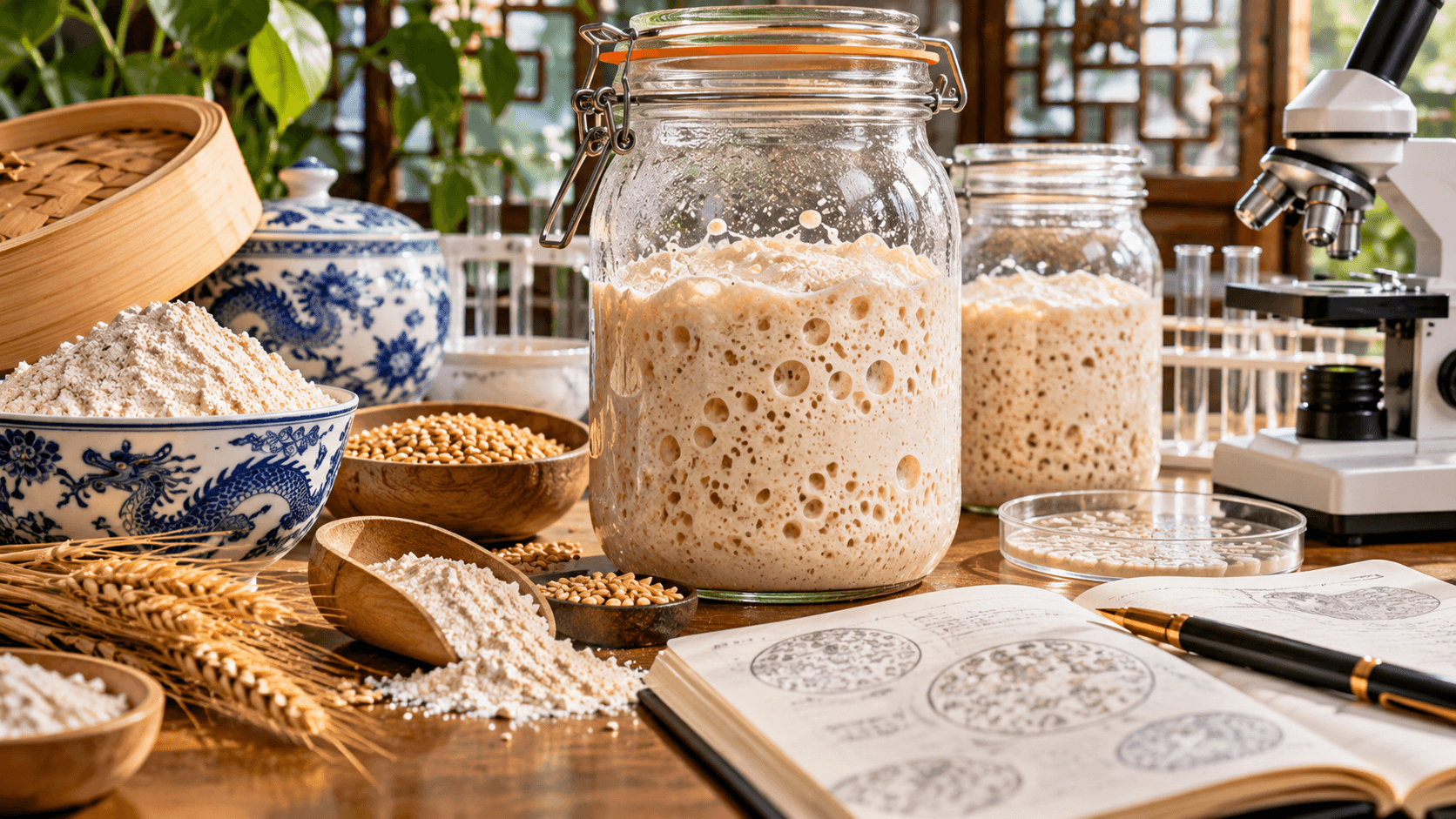 AI generated photo for American Sourdough Association. |
What to Watch During the Feeding Cycle
Write down the feeding time and room temperature. Check both jars periodically while you are awake, noting changes without stirring the mixture. If a jar looks suspicious or contaminated, stop observing its aroma.
Compare the jars at similar fermentation stages, not only at the same clock time. One might reach its highest level while the other is still expanding. Record both the elapsed time and observations near peak.
Use descriptions that you can recognize next time. For example, write “mild grain aroma, about doubled, still rising” instead of simply “better.” These are example observations, not predicted results. The starter maintenance guide can help you establish a consistent routine.
Repeat the comparison over two or three feeding cycles if both cultures remain healthy. Keep the same flour, feeding weights and temperature within each test. If a difference disappears on the next feed, do not assume the first result represents a permanent change. |
 AI generated photo for American Sourdough Association. |
Turn Your Observations Into Better Baking Decisions
If your whole wheat jar consistently matures sooner, you may want to adjust when you prepare your levain rather than assuming that a stronger scent means stronger bread. Use a familiar sourdough boule recipe for any later loaf comparison and keep the dough formula and baking method steady.
Judge the bread separately from the starter. Record dough handling, proofing, cooled crumb and flavor. A fruity jar does not guarantee a fruity loaf.
When to Stop the Experiment
Discard the entire affected culture if you see mold or unexpected pink or orange streaks. Do not taste it or attempt to rescue a portion beneath the surface. Follow starter troubleshooting guidance and clean the equipment before restarting with your healthy backup.
An alcoholic liquid on an otherwise normally maintained starter can indicate that feeding is overdue, but its presence does not establish safety. Never use smell alone to decide whether a questionable starter is safe. If necessary, begin again using a reliable starter recipe.
The Takeaway
The best comparison is one that makes your everyday routine easier to understand. Keep the experiment small, document your observations and use the established sourdough techniques that already work in your kitchen. You do not need your starter to smell like anyone else's to bake a good loaf. |
53 Comments
Join the conversation
I like that this keeps the next loaf out of the experiment. I can compare the jars first and decide later which flour works for me.
Does the white flour need to be the same brand I normally use? I would rather change one thing at a time if I try this.
It is reassuring that a yogurt smell is not automatically better than a fruity one. I will pay more attention to how reliably my starter rises.
A fruity smell had me worried my starter was doing something wrong. I am glad the focus here is on how it rises and bakes.
My whole wheat feeds tend to smell stronger, though I have never compared them side by side. I will try the same ratio in both jars.
The part about protecting the next loaf won me over. I enjoy experimenting, but I would rather not use my whole starter to test a new flour.
I am not sure aroma will be easy to compare without writing it down right away. Rise and time to peak seem like the clearer measurements for me.
A quick aroma note at each check could help, but rise and time to peak are excellent measurements to focus on. Use the observations that are most useful for your baking routine.
I usually feed with whatever flour is open, then wonder why the starter behaves differently. Keeping one white flour jar as a baseline sounds useful.
I tried comparing flours once, but I fed the jars different amounts. Using a scale and the same ratio would make my results easier to trust.
The temperature note is important in my house. The counter by the window is much colder than the one near the stove, especially in winter.
The difference between noticing an aroma and diagnosing a culture is worth stating. I can describe what I smell without pretending I know which bacteria are there.
I appreciate the distinction between noticing an aroma and identifying microbes. It is easy to get too certain about what a fruity smell means.
Two clean jars seem like an easy Saturday project. I have been wondering whether whole wheat would make a noticeable difference to my starter.
That’s a great Saturday experiment. Feed both jars at the same 1:2:2 ratio so flour is the main difference you’re comparing.
I would be curious whether the whole wheat jar changes smell before it changes rise. That could be fun to watch over a feeding cycle.
This is a sensible experiment for people who only keep one starter. I appreciate that neither jar needs a huge amount of flour.
Recording the time to peak is a good suggestion. I usually notice that my starter rose only after it has already started falling again.
The aroma question drew me in, but recording temperature is probably what I need most. My starter behaves very differently in a cool kitchen.
I am a little skeptical that one feeding will show a clear flour difference. I might repeat the comparison a few times before changing my routine.
My friend and I started with the same culture and ours smell different now. It is nice to have a simple way to explore why.
I would mark the starting level on each jar before comparing the rise. Otherwise I know I would forget where they began.
Keeping the usual starter separate is the part that sold me. I like experimenting, but I still want to bake this weekend.
I switched to whole wheat for a week and noticed a stronger aroma. I wish I had tracked the rise too, since the smell alone did not tell me much.
The reminder that you cannot identify microbes by smell is helpful. I have seen a lot of confident guesses about what a fruity starter contains.
My kitchen temperature changes a lot during the day. I wonder how closely the two jars need to sit together for a fair comparison.
Two clean jars and a kitchen scale are easy enough to manage. I may try this the next time I feed my starter.
Owen BrooksMark the starting level on each jar. It makes the rise much easier to compare later.
I am glad the safety note says smell is not a reliable test. A pleasant smell would not make me keep a starter with visible contamination.
Tara W.Same here. If I see mold or odd colors, the whole jar goes, no matter how it smells.
Measuring time to peak seems more useful than trying to decide which jar smells better. That is something I could use when planning a loaf.
I use whole wheat whenever my white flour starter seems sluggish. I would be interested to see whether it actually peaks sooner in a side by side test.
The 1:2:2 ratio gives me a clear place to start. I appreciate having the same feeding ratio in both jars so the flour is the main change.
My starter smells fruity some weeks and more like yogurt other weeks. I had not thought to check whether my feeding schedule was part of it.
I like the idea of splitting one mature starter between two jars. It makes the flour comparison feel manageable without risking the starter I use for bread.
I would be careful about drawing conclusions after one feeding. If the whole wheat jar peaks earlier, I would want to see whether it happens again.
My friend and I shared a starter last year, and ours smell different now. We use different flour, so this gives us something concrete to compare.
The 1:2:2 ratio is helpful, though I wish there were an example in grams. I am new to weighing feeds and would check my math twice.
Marcus LeeFor each jar, you could use 10 grams of starter, 20 grams of flour and 20 grams of water. I had to write it down the first few times too.
I like the focus on noticing a useful difference rather than finding a perfect smell. My starter has baked good bread through several changes in aroma.
We’re glad that resonated. A change in aroma can be interesting without meaning there’s one ideal smell to chase.
This makes a flour change sound less intimidating. I would still keep my usual white flour jar going until I know what the whole wheat feed does.
That’s the idea: keep your usual white flour starter as a baseline while you see what changes in the whole wheat jar.
I tried whole wheat once and thought my starter rose faster, but I never measured it. Two marked jars and a scale would settle my curiosity.
The safety note matters. A pleasant smell would not convince me to keep a jar with visible contamination, even if I had spent days feeding it.
I have always judged my starter by its smell first. Watching the time to peak as well might give me a better picture of how it is doing.
Using the same mature starter for both jars is a sensible place to begin. I like that the next loaf does not have to depend on the experiment.
Elaine M.Exactly. I’d keep my usual starter going separately so I can still bake this weekend.
I am curious how much the room temperature will affect this test. My kitchen gets quite cool overnight, so I will record that along with the rise.
Recording the temperature is a smart move, especially with a cool night ahead. Keep the jars side by side so they experience the same conditions.
I appreciate the reminder to keep both jars at the same feeding ratio. I would probably blame the flour for a difference I caused by feeding them unevenly.
My starter smells fruity some weeks and more like yogurt other weeks. It helps to know that smell alone cannot tell me which microbes are in there.
The two-jar comparison feels manageable for a home baker. I can try whole wheat in one jar without changing the starter I use for my weekend loaf.