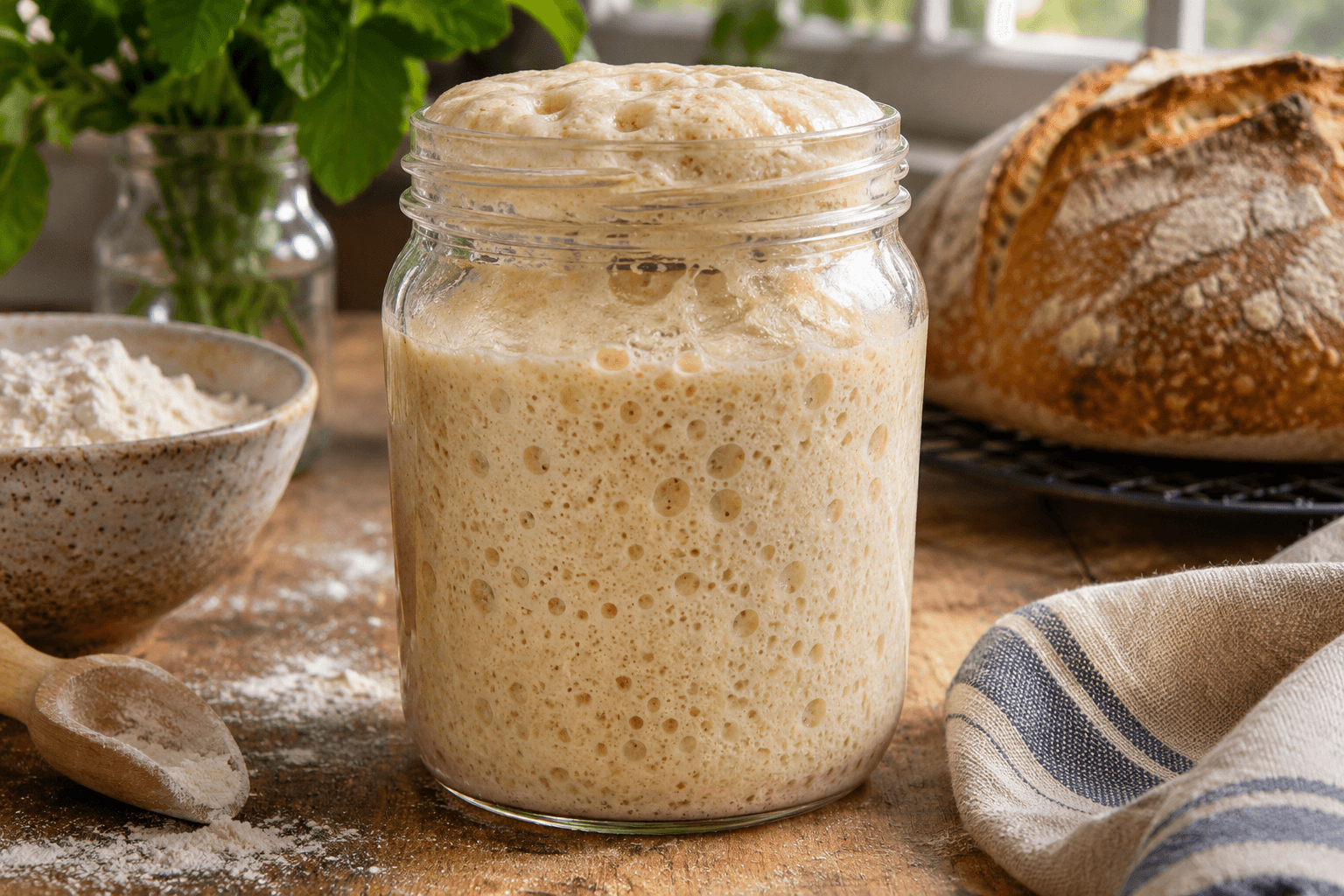
Open a jar of ripe sourdough starter and you might notice yogurt-like tang, ripe fruit or a gentle yeasty sweetness. Bake the dough and those scents give way to a fragrant crust. Where does all that complexity come from?
Sourdough aroma is the combined work of fermentation microbes, their ingredients and the cooking process. A new food microbiology study offers a closer look at the compounds behind fermented dough's distinctive smell. For bakers, it is an invitation to pay more attention to what happens between feedings.
At a Glance
What the New Sourdough Aroma Research Found
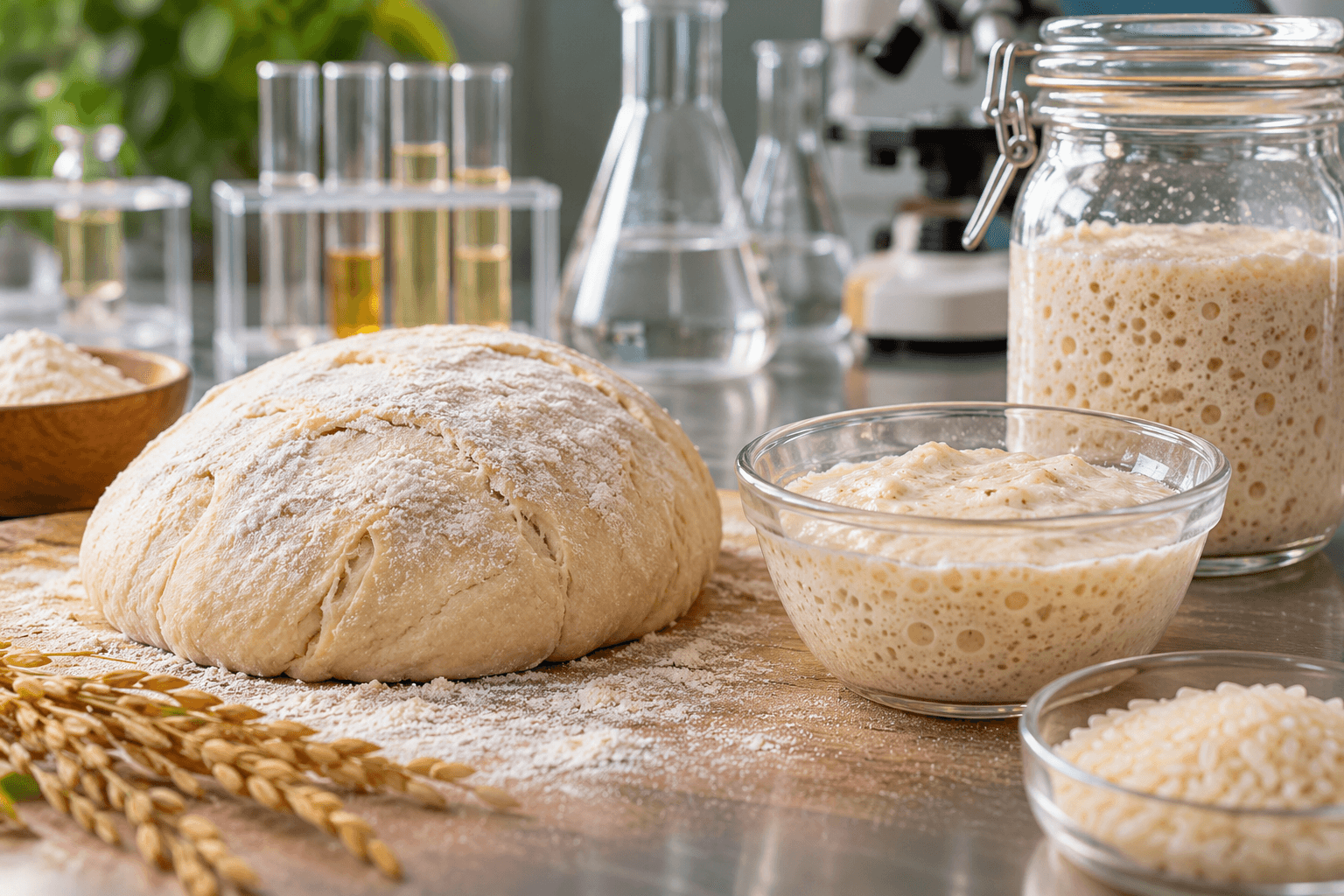
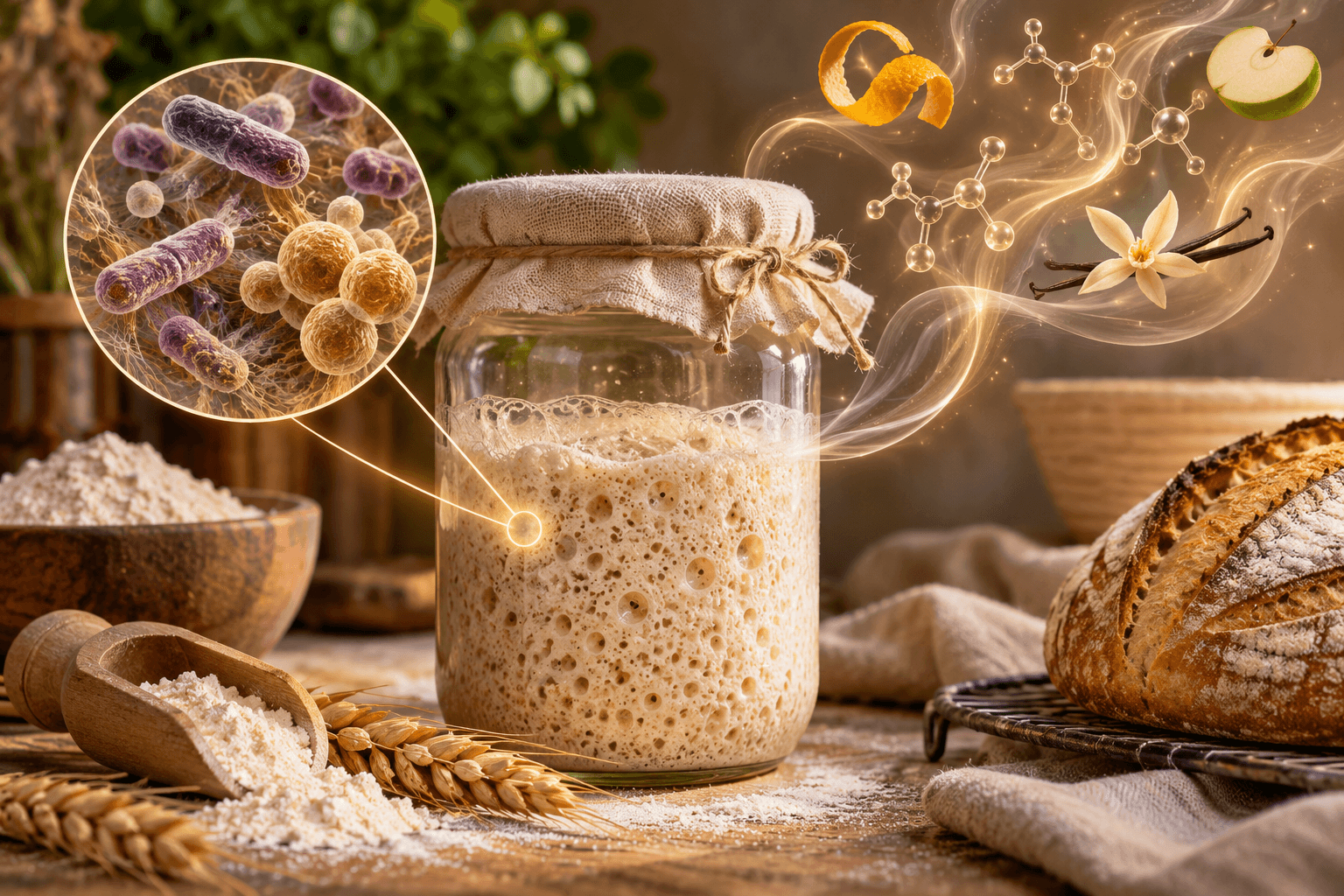
The original research paper examines the relationship between microbial communities and volatile compounds in traditional Chinese sourdough. Volatile compounds are substances that can enter the air and reach our noses.
The researchers detected 109 of these compounds and identified 11 as particularly important to aroma. The reported microbial associations involved 25 potential flavor-producing microorganisms, including Saccharomyces cerevisiae and Lactiplantibacillus plantarum.
Detecting a compound does not mean it contributes equally to the smell. Some substances can be noticed at very low concentrations, while others need to be present in larger amounts. The mixture matters as much as the individual components.
The study record concerns steamed-pastry sourdough, not a controlled comparison of home-baked crusty loaves. Microbial associations do not prove that adding one particular organism will create a predictable flavor in your starter.
|
 AI generated photo for American Sourdough Association. |
Why a Starter Develops So Many Different Scents
A mature sourdough starter contains a community of yeasts and lactic acid bacteria. As these organisms use available nutrients, they produce acids, alcohols, carbon dioxide and other metabolites. The balance changes as fermentation progresses.
Yeasts help generate carbon dioxide that contributes to dough expansion. Lactic acid bacteria contribute acidity and can participate in the formation of flavor-related compounds. Both groups interact with the flour and with one another.
The sourdough guide provides a useful starting point for understanding starter behavior in a home kitchen. A bubbly starter can have several overlapping aromas, and two healthy starters do not have to smell identical.
From Fruity to Tangy: What Your Nose Can Tell You
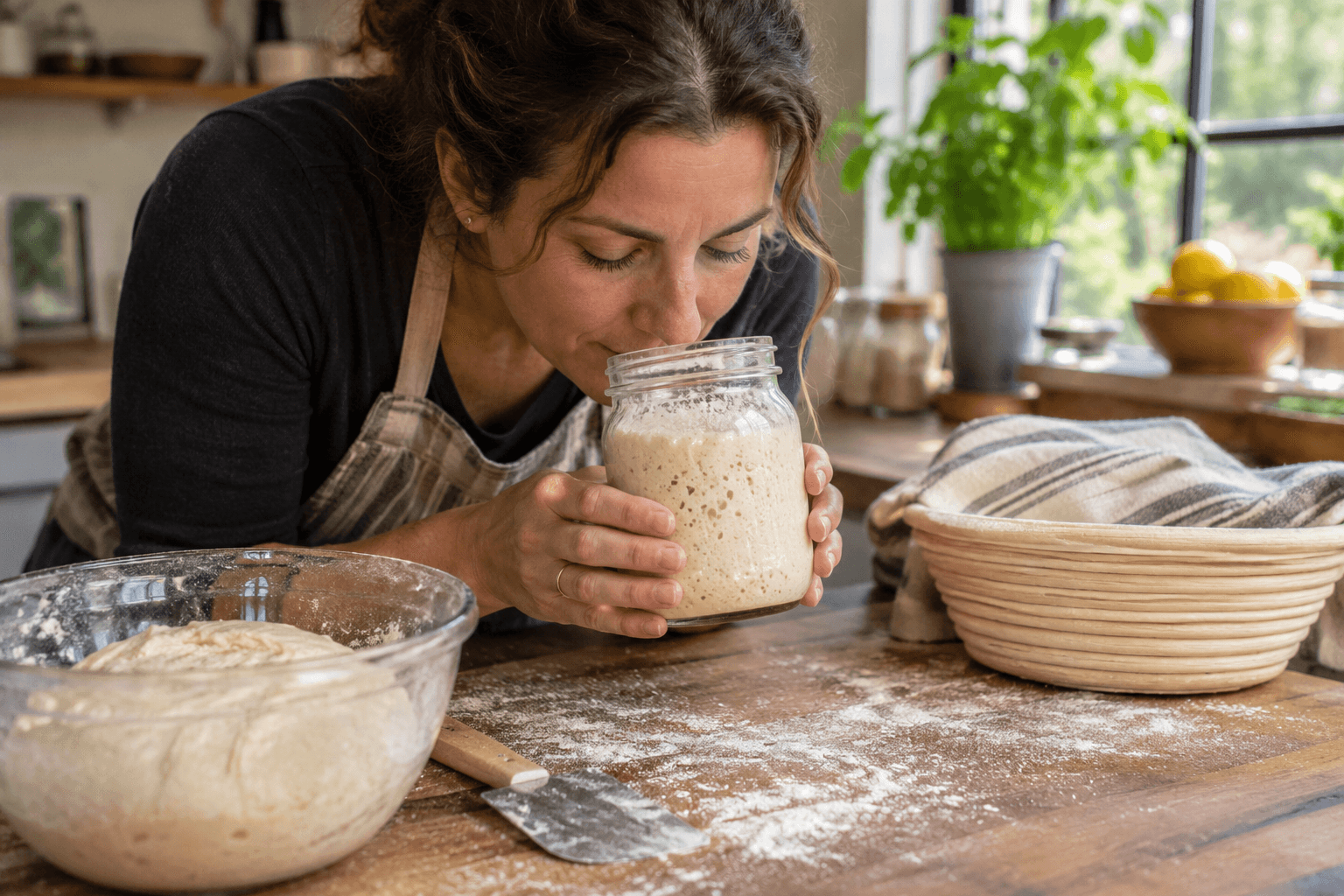
Freshly fed: The smell may be dominated by damp flour, grain and the diluted aroma of the previous starter. A mild scent immediately after feeding does not necessarily mean fermentation is weak.
Actively rising: Fruity, yeasty or gently tangy notes may become more noticeable as microbial activity progresses. Watch for bubbles and increasing volume as well.
Past peak: A more pronounced acidic or alcoholic smell can develop as the starter runs low on available food. If the starter regularly collapses well before the next feeding, consider reviewing your feeding schedule.
These are possible observations, not a reliable method for identifying individual microorganisms. A fruity smell does not tell you which yeast species is present, and a tangy scent alone does not establish that the starter is ready to leaven bread.
Starter Aroma Is Not the Same as Baked Bread Aroma
Fermentation supplies some aroma compounds and flavor precursors. Baking adds another layer through heat-driven reactions, especially browning at the crust. A steamed pastry and a deeply browned sourdough boule therefore develop different aroma profiles even when fermentation shares some underlying chemistry.
When making a rustic sourdough loaf, consider crust color, crumb texture, and the finished aroma together. A strong-smelling starter is not a guarantee of a more fragrant baked loaf.
|
 AI generated photo for American Sourdough Association. |
Four Fermentation Variables Worth Watching
Flour: Different grains and extraction levels provide different nutrients and enzymes. Changing from white flour to whole wheat or rye may alter both fermentation speed and aroma. Keep your usual starter maintenance routine consistent when testing a flour change.
Temperature: A warmer environment generally speeds microbial activity within a suitable range. Cooler conditions may extend the time needed to reach peak. Avoid assuming that warmth always produces a better flavor or that a cooler starter must be more sour.
Feeding ratio: The amount of fresh flour and water relative to retained starter influences how quickly a culture progresses through its feeding cycle. A larger feed may take longer to mature under otherwise similar conditions.
Fermentation time: Aroma changes as available nutrients are consumed and metabolites accumulate. Compare starters at similar stages, not simply at the same clock time.
Change one variable at a time if you want to understand what actually affected the result.
Try This: A Simple Two-Jar Aroma Experiment
Use a healthy established starter and two clean, food-safe containers. Keep a separate portion of your normal starter as a backup. This is an observation exercise, not an attempt to reproduce the laboratory's microbial analysis.
Use the starter feeding guide to help maintain your regular culture. Compare the two jars at equivalent stages of development as well as elapsed times. A cooler jar may simply be less mature when the warmer one peaks.
Do not taste raw starter or raw dough. Flour is a raw food that can carry harmful microorganisms, as explained in the FDA's flour safety guidance. Observe aroma gently without placing your face inside the container.
|
 AI generated photo for American Sourdough Association. |
When an Aroma Is a Warning Sign
An acidic or alcoholic smell can occur in a hungry starter, but visible mold or unusual pink or orange discoloration is a reason to discard the entire affected culture. Do not scrape off mold and keep the remainder.
If contamination is suspected, avoid sniffing the jar closely. Clean the equipment and begin again with a healthy backup or follow a reputable new starter recipe. Smell alone cannot establish food safety.
What to Record in Your Baker's Notebook
Keep your bread formula and baking method stable when comparing results. The sourdough baking guide can help you troubleshoot changes in dough development without attributing every difference to the starter's scent.
The Bottom Line
A wonderful sourdough aroma comes from a complex combination of microbes, fermentation conditions and cooking reactions. The new research adds detail to that picture, but it does not prescribe a universal formula for the most fragrant loaf.
Use your nose as one observation tool, alongside rise, timing and temperature. A consistent feeding routine and a few careful comparisons can teach you more about your own starter than chasing a particular smell. Keep experimenting, record the results and let the finished bread be part of your evaluation.
Hero photograph is illustrative. Photo: Monserrat Soldú/Pexels.
|
29 Comments
Join the conversation
The best part for me is the reminder not to chase one perfect sourdough smell. A starter can change and still make good bread.
My starter has smelled different after a missed feeding, even when it still rose fine. Paying attention between feedings sounds sensible.
I wonder whether the flour used in those steamed pastries affected the aroma as much as the microbes did. Ingredients seem important here too.
Aroma is easier for me to check than measuring exactly how much my starter rose. I like having another clue about its progress.
I bake mostly crusty loaves, so I would be careful applying the steamed pastry results to my bread. The general advice still seems useful.
The gentle yeasty sweetness is what I look for after feeding my starter. Now I am curious what it smells like a few hours later.
I had no idea some aroma compounds could matter even at very low levels. That explains why the biggest number is not necessarily the important one.
Tracking scent sounds useful, but I would need a few plain examples of what to write down. Fruity and tangy are a good start.
My grandmother made steamed buns with a sourdough starter, and the smell was gentler than my baked bread. This brought that back.
The study sounds promising, but microbial associations seem a long way from a recipe. I appreciate that the takeaway stays modest.
Rick S.Agreed. I like knowing what the researchers found without being promised a way to make my starter smell a certain way.
I would love a follow-up on whether different feeding schedules change those key aromas. That would be especially useful for home bakers.
Sofia K.I'd read that. A comparison of feeding once versus twice a day would be useful.
Twenty-five possible flavor-producing microbes is a lot to keep straight. I will stick with watching how my own starter changes over a week.
The ripe fruit description fits my starter some days. I used to wonder if I was imagining it, so this was fun to read.
I am glad the steamed sourdough was identified clearly. It would be easy to assume these findings came from the usual home-baked loaf.
It makes sense that baking changes the smell so much. The scent from a starter jar is nothing like the crust coming out of my oven.
My kitchen gets much warmer in summer, and the starter smells different then. I may start recording temperature with my feeding times.
Kim L.Same here, mine gets fruity much faster in July. I should start writing down the kitchen temperature too.
I usually judge my starter by how high it rises. Checking its aroma at the same time seems like an easy habit to add.
That distinction between what scientists can detect and what our noses notice is helpful. I had assumed every compound counted about the same.
The research is interesting, though I wish there were more about how the steamed pastries actually smelled to the people testing them.
I appreciate the caution about adding one microbe and expecting a certain flavor. Sourdough has never been that predictable in my kitchen.
My starter often smells like yogurt right before I feed it. It is reassuring to see that described as one of the normal aromas.
Elaine PorterMine does too, especially when it's due for a feeding. I worried about that smell when I first started baking.
Finding 109 compounds sounds impressive, but the point about only 11 being key to the aroma helped me understand what that number means.
I never thought about how much the smell changes between feedings. That gives me something useful to watch for besides bubbles.
The steamed pastry detail matters. I would be curious to know whether the same 11 aroma compounds stand out in a crusty loaf.
I like the suggestion to track smell along with rise. My starter smells fruity some mornings and much sharper on others, so I may start taking notes.